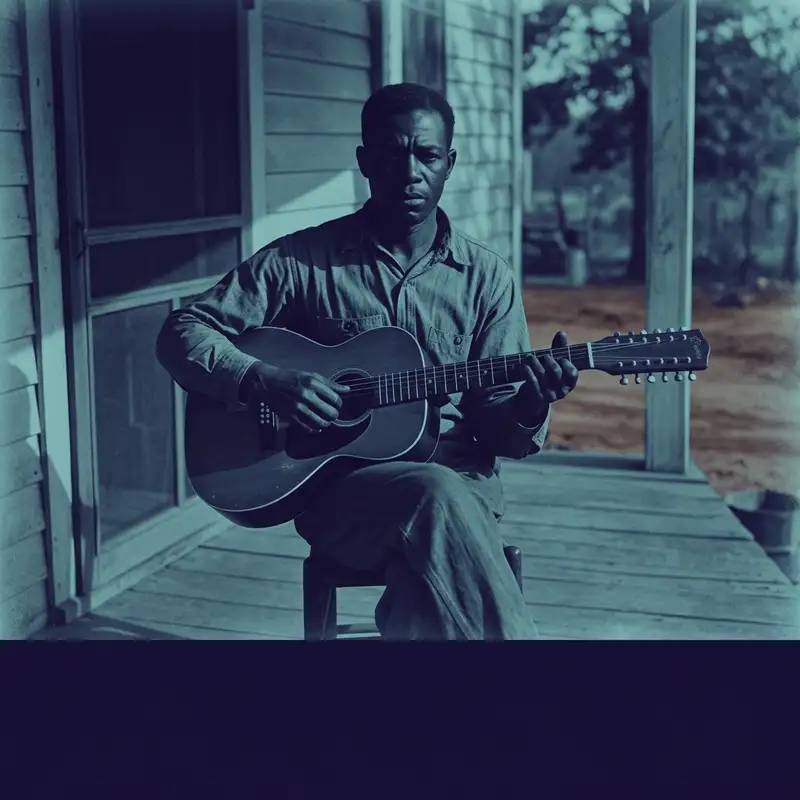
The Blues Professor, Part 1: Piedmont Blues, the Allman Brothers, and Atlanta's Living Scene
Download MP3Groundwater — Rich Pettit (Part 1)
===
Thomas: [00:00:00]
Rich: The kinda stuff that the Allman Brothers Band or Led Zeppelin played, the early Rolling Stones all that stuff I just loved. And, I'd buy the albums and I'd see, some of these songs are covers.
Introduction
---
Speaker 4: This is Groundwater. I'm Thomas Stubbs. A special episode this time, the first of two. Most weeks it's just me and the records following the blues up out of New Orleans one chapter at a time. This week, I wanted to sit across from someone who spent his life inside the music instead of writing about it.
That voice you just heard is Rich Pettit. In Atlanta, they call him the Blues Professor. He's been on the air at WRFG 89.3, down at the community end of the dial for forty years, where he hosts a show called Good Morning Blues. He was born and raised in New Orleans, and he came to the blues the way a lot of us did, backwards through classic rock, until he started noticing how many of those songs were [00:01:00] covers.
it's coming to you in two parts. Part one is where the blues comes from: Africa, Congo Square, the banjo nobody remembers as African, and where it went from there. The live scene that's still going on in Atlanta, the Piedmont players who taught each other on back porches outside Covington, Georgia, and how the music climbed the East Coast and rode the rail north.
Part two, we get to Chicago. Here's Rich
Thomas: you're known as the Blues Professor. You've got an early morning show. I used to I used to have an early morning show when I was at the University of Georgia.
Rich: WUOG
Thomas: yeah 90.5 FM. I used to guest on the blues show there and the folk show, and I didn't know much at the time about the blues. So I kinda... Sure. I was a student, so you kinda learn by going through the records and figuring out what you like. How did you come to it?
Rich: Got into the blues [00:02:00] because I was a fan of what's now considered classic rock, and a lot of these classic rockers really you'd call them blues-rock bands today.
The kinda stuff that the Allman Brothers Band or Led Zeppelin played, the early Rolling Stones all that stuff I just loved. And, I'd buy the albums and I'd see, some of these songs are covers. And this Morganfield guy or this Burnett guy, you'd,
Thomas: Some of them attributed covers, and some of them not so much.
Rich: Yeah. Yeah, the, uh, some lawsuits. Uh, Willie Dixon won a lawsuit for an undisclosed amount from Led Zeppelin- That's right ... for taking one of his songs.
Thomas: Yeah,
That's right. He had to fight for that. As the Rolling Stones were a little bit better at acknowledging their, where their history came
from- Yeah,
Rich: yeah, definitely. So a famous story about them insisting on having Howlin' Wolf on a television show in UK- What's that one? ... that they were on to say he's [00:03:00] gotta be on there, too.
Thomas: Oh, that's fantastic. Yeah, I know they, they made some they made some trips specifically to to, to get close to the source, right?
And, Yeah ... of the Delta blues. . I think one of the albums I found most surprising and from the British r- rock bands was the listening to the first Jethro Tull album. I can't remember what it's called, but it is basically a blues album.
Rich: Yeah. When I first fell in love with Tull it was Aqualung.
Sure. And I don't think I'd bought anything earlier than the Benefit album, but then when the box set came out, they had a cover of them doing Stormy Monday Blues. Yeah. And as I did a little research, I found out, yeah, they started out as a blues-rock band just like all those other UK
rock bands.
Thomas: So you were... you started with classic rock and and went kinda upstream. And you told me earlier you got a place in New Orleans. Are you from New [00:04:00] Orleans?
Rich: Yeah, I was born and raised there, and then I came to Atlanta as a Emory undergraduate, and returned to New Orleans after college to do grad school at Tulane.
Yeah. And tried to get a job in New Orleans, but the economy was hurting at the time, so zipped back up to Atlanta and have been here ever since. So I've been a full-time Atlantan since January of 1986.
Thomas: That's a good long time, yeah. And
Rich: I've been on WRFG since 1986. This is my 40th year volunteering there.
Thomas: Any plans to retire?
Rich: No, of course not.
Thomas: No. Good.
Rich: It is a fantastic s- station. And New Orleans famously has a great volunteer i- station. Or is it volunteer? I'm not sure it's volunteer. It's certainly independent.
Yeah, WWOZ is- Yeah ... is volunteer. Whenever
Thomas: really missing New Orleans I stream that station.
Rich: Yeah.
I'm tuned in all the time.
[00:05:00] Thank goodness for the internet for making radio a worldwide audience.
Thomas: So since you've been doing this 40 years the music scene in Atlanta has evolved a lot. It's it's now a kind of center of hip hop. But from the perspective of the blues, what have you seen evolve
Rich: in the music scene here That's a good question. Certainly a lot of the older African American artists have passed away or are no longer performing which is a shame because the blues originated with Black people. And it's always been a part of Atlanta since the 1930s. The live music scene is strong.
There's s- still Blind Willie's and Northside Tavern having blues five or more days a week. And you do see it offered in a lot of [00:06:00] the- Yeah ... other venues around town.
Thomas: the barbecue place on Piedmont Fat Matt's.
Fat
Rich: Fat Matt's Rib Shack. Yeah, so Fat Matt's continues to have blues, I believe seven days a week.
I wanted to talk about when you think of the source of the blues, it came from Black musicians. And when you trace it all the way back, where do you find? Where do you land?
Origins of the Blues
---
Rich: The first blues was recorded in 1920, but certainly it was around before then.
[00:07:00]
Rich: I think I've listened to all the important old stuff that's ever been recorded.
The other stuff you could get a feel for what it might have been- ... listening to some of the older stuff particularly some of the field recordings that Lomax made, for instance.
But yeah I think, I don't know where the beginning is. We know that it came from Africa and it came- Yeah ... over with the enslaved- Yeah ... people. And it- slowly evolved. They had mostly percussion- Yeah ... in the beginning
Thomas: And they- And the banjo,
Rich: basic stringed instruments.
Yeah. Yeah.
Thomas: Yeah. That surprises a lot of people that the banjo is a West African instrument, but the musical tradition of West Africa is strong.
So I've been doing research for a [00:08:00] book I'm working on.
And this show is called Groundwater, and when I started looking at this I'd heard about the Sunday Exception in New Orleans, which was an exception where by law slaves were not allowed to work on Sunday. They were also required to be Catholic. But the Louis Armstrong Park is where there were gatherings.
Of course, it wasn't the Louis Armstrong Park
Rich: It used to be called Congo Square- that's right ... back in the days when the enslaved people would gather there to make music-
and socialize on Sunday. Then it became Beauregard Square- Beauregard. That's right ... when post-Civil War we're gonna honor General P.G.T. Beauregard by naming it after him. Yeah. And then after Louis Armstrong passed, it was decided to do a major renovation of the park and it's borne his name ever since.
Of course- ... the airport in New Orleans is also- [00:09:00] Yeah ... named after Louis. And yeah, there's no more important musician to have come from New Orleans than Louis Armstrong.
Thomas: You play 1920s all the way to the present and don't shy from any particular style. I wonder your point of view on the genre lines. You talked about, coming to the blues from classic rock. But blues, country, R&B, rock, are these, lines real, or are they more of an record industry division?
Rich: Oh, I think they really help listeners kinda find what they want that, that find the stuff that they will enjoy. But I believe, there's always gonna be some cross-pollination, so there's no pure standard form of jazz or rock or blues or country. These are forms that they have a lot of characteristics, but a song doesn't have to include all those characteristics to be a blues [00:10:00] song.
Thomas: No. Indeed. I'm struck by how close
blues and
country and bluegrass are. They share a scale of course, but
are you familiar with the Allman, All- Allman Brothers cover of Robert Johnson's Come to My Kitchen?
Rich: Yeah. Yeah.
that opens
Thomas: as a delta blues song.
And closes as a bluegrass song. I've always been really struck by that recording by how it just switches in, in, in the middle. It's it's really telling how close these traditions or these, this music is together.
[00:11:00]
Thomas: All right. So
What's a record that you've you've played champion for years that never got its due?
Rich: Phew. That's one I gotta give a little thought to. Y- might be like a, an, might be more likely that it's an artist that really never got their due. Just one I think about frequently, Larry Garner, a Baton Rouge blues man who was a great... Still alive. He's a great songwriter, a good guitar player, kinda in the B.B. King style. Recorded for a number of labels, but yeah, he yeah, he's finding it hard, I think, to find concert dates to play.
They they won't book you if you're not gonna sell enough tickets.
Thomas: Yeah.[00:12:00]
There's a a venue in Atlanta that is, doesn't do much blues. It's it's called Grocery on Home, and it's run by a man named Matt Arnett. It's it's in the old grocery store on Home Avenue in Grant Park. And-
Rich: I've not been there
Thomas: The
reason I mention it y- you were talking about him having trouble finding gigs is Matt runs the open mic at Eddie's Attic.
And- Oh, yeah ... yeah.
Rich: very
Thomas: he discovers musicians there and has them into the old grocery store, which is like a large living room.
It seats probably 60 or 70 people. There are no tickets sold. There's there's free beer in the refrigerator because a friend of his runs a brewery. But the the extraordinary thing is the hat is passed, and the musician takes all of all of the proceeds. And it's been a fantastic jumping-off point for a lot of singer-songwriters.
And some of them blues artists.
Rich: I just remembered the name of the blues musician that I've seen at the [00:13:00] Grocery. I wonder, have you heard of Lonnie Holley?
No.
Thomas: He's come to the music late in life. He's a folk artist from a very large family.
I believe his Wikipedia page says that his father sold him for a bottle of whiskey. But one of the things that's unique about him is that he does not pre-write his music. He extemporizes the blues live,
and
it's fantastic. It's also a high-wire act. Yeah. So I've seen it be, like, mind-blowingly good, and I've seen it being, "Oh, that's not
Rich: Yeah. Yeah, they said Lightnin' Hopkins was like that. Is that right? So yeah he would perform... It'd be a similar song, but yeah, it was performed very different every time he took the stage.
Thomas: I didn't know that. I'll I wanna dig into that more. Anybody else you're aware of that, that performed like that?
Rich: Oh, yeah, what I do like about blues music [00:14:00] is as opposed to maybe going to a major concert, a lot of those artists that they come out and they're gonna do, the same show night after night, and the blues artist they seem to have larger repertoires and they don't want any of those songs to be ignored, so they work them all in along with the fan favorites. Yeah you're always surprised, even if it's somebody you've seen dozens of times. Like Mudcat here in Atlanta.
The other thing that's really unique about these shows is you often don't have any idea who's playing, and the reason for that is that if someone's coming and playing the Variety Playhouse or even sometimes The Fox or or Eddie's Attic,
they've
Thomas: got a published show. And the contracts for these published shows are you can't have another published show the same week- Yeah
in the same city. And so the loophole in this is is that he doesn't publish the shows. He just says, "I've got a show at The [00:15:00] Grocery. It'll be a $30 donation,"
and
that's it, and packs the house every time.
Rich: Yeah. But that was a show y- the Kirkwood neighborhood does this Lanta Gras celebration- Yeah ... which always includes live music. And I found out the morning of Lanta Gras that Rebirth Brass Band was gonna be there playing for free. Rebirth had played Center Stage the night before, and so that's why they couldn't an- Yeah
announce it and...
Thomas: Yeah.
Re- reminds me, Legion Field at La-- sorry, Athens, Georgia Legion Field.
There's Legion Pool, Legion Field. They used to have concerts out there when I was at the University of Georgia. Again, sometimes the blues is foisted upon you, right? I didn't know the Dirty Dozen Brass Band. I just knew that they were supposed to open for Michelle Shocked And went to the concert, and everybody's looking at their watch 'cause The Dirty Dozen aren't there.
Rich: [00:16:00] Yeah.
Thomas: And so Michelle Shocked goes on, and then there are, like, four vans pull into the backstage area, and all these guys are r- like rolling out of these vans with their instruments and family members, and, it was just... they just had driven up from New Orleans, and they were late.
And Michelle Shocked sees these guys and invites them up to play with her horn section. I don't know whether they regretted this or not but to say that they didn't just blow Michelle's horn section off the stage they were, amazing. And so that's how they got to play even though they were late.
Wow. They just joined the- Fun ... the headliner.
Rich: I lo- I love unexpected stuff like that, sometimes a mistake like that can lead to- to, to great things.
Piedmont Blues & the East Coast
---
Thomas: talk a little bit about the different sorta threads and streams of the blues. We talked about the Lomax recordings. A lot of these songs came from f- field [00:17:00] hollers and, and going back wherever they came from before then.
there
a sort of thread during the Great Migration when Black people, because the South was brutal and horrible took the Illinois Central Railway from New Orleans, right up through St. Louis and Memphis and Kansas City and got to Chicago and plugged in their instruments.
And we have this Chicago blues tradition that, comes right up the river, but on the rail more than the riverboats. I'm interested in in, and I don't know really much about why and what makes Piedmont blues different or where it particularly comes from. I know about Blind Willie McTell playing at the Pig & Chick barbecue here in, in Atlanta.
But how does the music get up the East Coast to New York City? And where did it come from on the Piedmont side?
Rich: I can partially explain that, I believe. So on a really important figure on the [00:18:00] Piedmont side was Savannah Weaver, who was Curly
Weaver's
mother, Cora Mae Bryant's grandmother.
But she not only taught Curly, who was an excellent guitarist how to play, she taught Bar-B-Q Bob Hicks, she taught Blind Willie McTell Buddy Moss. And they lived in Rockdale County, Georgia
Right near,
Covington.
Thomas: Yeah, not far at all.
Rich: And so those guys, they would play together a lot.
There's a lot of recordings of McTell and Weaver together and then you get the George Browns and so forth. That, that was a pretty strong core, and a lot of them made it to Atlanta. And Atlanta was
A site of early blues recordings. So during the 1930s up until World War II started, there was a good bit of [00:19:00] recording activity in Atlanta, and these were labels that were based in typically New York, maybe Chicago as well.
So that got the music out
on a national scale 'cause they're getting recorded. And then you had, The influence of Lead Belly, Sonny Terry, Brownie McGhee up in New York City, who got hooked in with Woody Guthrie and some of the people in folk music. Gave it a stronghold in Greenwich Village in the late '50s and early 1960s.
And and New York was highly influential in, in the music business. Still is.
Thomas: And black blues musicians leaving the South and the Piedmont area for the same reasons they were leaving Mississippi and Louisiana.
Rich: Yeah. Yeah, obviously it's gonna be a lot of work in New York. It was the largest city in the
Thomas: I've been in Chicago a lot the last several years, and so I've been I f- [00:20:00] have a favorite venue now, which is Blue Chicago.
And it's a pretty tiny place, but the quality of the musicianship there is always fantastic.
Rich: Yes. They have so much good music in Chicago. And of course, they just had the big free blues festival, which I've only been to once. I'm hoping to go again really soon.
Thomas: Yeah, I hope to go to that as well. I saw it advertised when I was up there, but I just my, my trip just didn't coincide this time. You grew up in Chica- in New Orleans. New Orleans is is my favorite city. I did not grow up there. But Tennessee Williams said that there were three great American cities.
Do you know this line?
Rich: Yeah. Yeah, New Orleans, San Francisco, and New York, I believe. That's
Thomas: right. A- and the, everywhere else is Cleveland- ... is what he said afterwards. Which I think is a little unfair to Chicago and LA and a couple of other places, but, I get the sentiment. And I think New Orleans, is the most important city in America, partly [00:21:00] because of it's the place that really birthed 20th century American music.
The blues comes out of that area, and was cooked like a roux in New Orleans, and then starts spreading out. And without that, you don't get the British invasion. And so when
Rich: think about- Yeah.
And one could argue, that New Orleans really helped birth R&B.
Thomas: Yeah. Oh for sure. And there's a hip-hop, a branch of hip-hop called bounce that comes uniquely from New Orleans.
Rich: Yeah.
Big Freedia.
Thomas: Big Freedia, that's, that, that's right. And that's a whole other conversation.
Speaker 5: A whole other conversation. That's where we'll pick it up next time. This has been Groundwater, a special episode, part one of two, with Rich Pettit, the blues professor of WRFG in Atlanta. I'm Thomas Stubbs. The book this show comes out of is called Race Records: The Lie That Split American Music and the Blues That Ran Underneath.
In part two, we [00:22:00] follow the music up the line to Chicago from New Orleans, the case for it as the most important city in American music, what Muddy Waters could do to a room and the records Rich would put in your hands if you were walking into the blues for the first time and didn't know where to start.
That's part two. Wherever you found this one, everything lives at groundwater.fm. Thanks for listening, and Rich, thanks for the afternoon