The Underground River, Part 1: Blind Willie McTell, the Rolling Stones, and Led Zeppelin
Download MP3Groundwater — Episode 10
The Underground River, Part 1: Blind Willie McTell, the Rolling Stones, and Led Zeppelin
Host: Thomas Stubbs. Runtime 20:56.
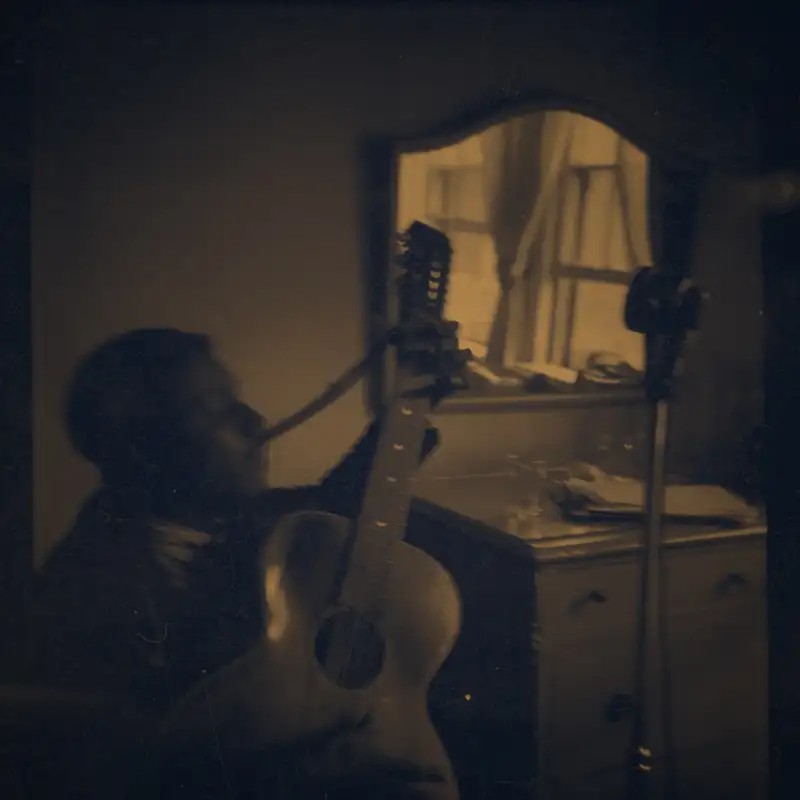
[00:00] Atlanta, November 5th, 1940. A room at the Robert Fulton Hotel. John Lomax has a disc recorder set up. He is seventy-three, a Texan collecting folk songs for the Library of Congress. His wife Ruby is with him. Across from them sits a blind man with a twelve-string guitar. They found him the night before, playing for tips at a barbecue drive-in on Ponce de Leon Avenue.
[00:28] Lomax wants a particular kind of song, and he asks whether the man knows any songs about colored people having hard times here in the South. Any complaining songs.
[00:44] [ARCHIVAL RECORDING: John A. Lomax and Blind Willie McTell, Library of Congress, Atlanta, November 5, 1940]
LOMAX: I wonder if you know any songs about colored people having hard times here in the South?
McTELL: Well, that's all the songs that have a reference to our old people here. There hasn't been very much stuff of the people nowadays, because—
LOMAX: Any complaining songs? Complaining about the hard times, and sometimes mistreatment of the whites? Have you got any songs to talk about that?
McTELL: Not the way out. Not at the present time, because the whites are mighty good to the Southern people, as far as I know.
[01:20] As far as I know.
[01:24] A blind Black man in a hotel room in Georgia in 1940, with a white stranger's machine cutting every word into a disc. He doesn't say he won't sing one. He says he doesn't know any. He knew. He had lived his whole life inside what those songs described. It is as careful a reading of a room as you will ever hear on a record.
[01:53] His name was Willie McTell.
[01:55] [MUSIC: "Guitar Rag," Sylvester Weaver, OKeh, 1923 — series theme]
[02:05] There's a blues club in Atlanta named after him, called Blind Willie's.
[02:12] This is Groundwater. I'm Thomas Stubbs. This is Episode 10, The Underground River, Part One. At the end of the last episode, I promised you a man in a rhinestone suit and a father and son. They're coming, next episode. But first the river has to go under. This episode is about men who were standing where it went down, and also about who got paid when it came back up.
THE PARKING LOT
[02:48] The Pig 'n Whistle was a drive-in barbecue joint on Ponce de Leon Avenue in Atlanta, and Blind Willie McTell played its parking lot so often that a record label named him after it. He recorded under eight different names: Blind Sammie for Columbia, Georgia Bill for OKeh, Hot Shot Willie for Victor, Barrelhouse Sammy for Atlantic Records, Pig 'n Whistle Red for Regal. Eight different names, one pair of hands, and none of them paid enough to get him out of the parking lot.
[03:30] Blind Willie was born in Thomson, Georgia, around 1898. He was blind from early childhood. He went to schools for the blind in New York, Georgia, Michigan. He could read and write music in braille.
[03:47] He played the Piedmont style of blues, the East Coast blues, a little lighter than the Delta's. Fingerpicked so cleanly on a twelve-string that it sounded like two different guitars. The twelve-string was also a practical choice, because it was louder, and when you play outdoors for tips, you're competing with traffic and the sound of somebody's ribs sizzling. And volume, for Blind Willie, was survival.
[04:22] If you heard the Blues Professor episodes, you've already heard Willie's voice. It came from that same hotel room.
[04:32] His first recording was made in October 1927, for Victor. A year after that, the same label, same city, he made a song that truly outlived him.
[04:48] "Statesboro Blues." Blind Willie McTell. Victor Records. It was recorded in Atlanta on October 17th, 1928. You may recognize it from the original, or you may recognize a little band from Macon, Georgia, that later played it. But more on that later.
[05:12] [MUSIC: "Statesboro Blues," Blind Willie McTell, Victor, 1928]
[05:41] One man and one guitar. Listen to how much is going on under the voice. The low strings keeping time, high strings answer every line he sings, and a twelve-string guitar is sort of doing the work of a band. It's gonna travel.
[05:59] But the song didn't really travel when he was alive. He never had a hit. By the 1950s, Muddy Waters had truly electrified Chicago, and rock and roll was starting to eat everything. Willie McTell was still in Atlanta and still on the street, and his health was going. In '56, a guy that had a record store, his name was Edward Rhodes, found him playing for quarters, got him into the shop with a bottle of corn liquor, and turned on a tape recorder. Those were his last recordings, and Prestige released them after he was dead.
[06:48] Willie spent the last two years preaching the word at Mount Zion Baptist Church in Atlanta, Georgia. He died at the state hospital in Milledgeville, Georgia, in August of 1959.
[07:03] On his gravestone was the name Eddie McTier.
[07:08] A ninth.
THE BOTTLE
[07:10] The song keeps moving on. The great Taj Mahal recorded "Statesboro Blues" on his very first album, in 1968. A guy named Jesse Ed Davis played slide guitar. But the way Gregg Allman told it, he brought that record to his brother Duane, along with a bottle of Coricidin cold pills, because Duane was sick and kinda laid up and not really speaking to him. The accounts do disagree about the year.
[07:51] Duane played that record. He emptied the pills, soaked the label off the bottle, slid it over his ring finger, and taught himself slide guitar.
[08:03] In March of '71, the Allman Brothers Band recorded at the Fillmore East in New York over two nights. The album opens with McTell's song.
[08:17] That's "Statesboro Blues." The Allman Brothers Band, from At Fillmore East. Capricorn Records, recorded 1971.
[08:28] [MUSIC: "Statesboro Blues," The Allman Brothers Band, At Fillmore East, Capricorn, 1971]
[08:57] The sound is the bottle. Glass on steel, forty-three years after McTell's Victor session, at a volume McTell never got to hear, because he'd been dead twelve years.
[09:12] About seven months after these shows, Duane Allman was dead too. From a motorcycle accident in Macon. He was only twenty-four.
[09:23] In 1983, Bob Dylan sat down at a piano in New York, sat with Mark Knopfler playing on guitar, and they recorded a song named for Blind Willie McTell. It says that nobody could touch him. Dylan didn't put it on the album, and kept it for eight years.
[09:55] A blind man played a song in a parking lot in Atlanta. It resurfaces again with a slide guitar, and then out of a medicine bottle on a stage in the East Village in New York. You put something in the groundwater and it surfaces somewhere you did not expect, changed.
[10:17] The parking lot is still there.
THE LAUNDERING
[10:20] The blues had to cross an ocean twice before America would pay for it. In October 1958, Muddy Waters flew over to England to tour with Chris Barber's jazz band. And British audiences believed that they knew what an authentic blues was. It was acoustic and polite, like a museum piece. And what they got was Muddy with a Telecaster and an amp.
[10:57] The reviews were really rough, and Muddy blamed himself. He told Melody Maker that he didn't think British audiences were used to his type of singing. And then he flew home to Chicago.
[11:09] That sound, however, was heard by a couple of people. The two men who heard it, Alexis Korner and Cyril Davies, started a band called Blues Incorporated, and their nights in Ealing, and also at the Marquee, were where British blues sort of put itself together. Mick Jagger sang with them, and Charlie Watts played drums. That band broke up. One of the pieces named itself after a Muddy Waters record. You also heard that record two episodes ago: "Rollin' Stone," Chess, 1950.
[11:55] In June of '64, the Stones took two days out of a bad first American tour and made more than a dozen songs at 2120 South Michigan Avenue. Keith Richards told a story about that visit for sixty years, and I think he's still telling it. They walk in, a man in overalls is up a ladder painting the ceiling, whitewash running down his face, and that man is Muddy Waters.
[12:30] Marshall Chess says it never happened. Bill Wyman remembers Muddy helping carry their amplifiers in from the car.
[12:40] Now, I can't tell you whether Muddy Waters was on the ladder. A man doing manual labor in the building where his music made somebody else rich.
[12:50] The Yardbirds were the other school: Clapton, Beck, Jimmy Page. In 1968, Page built Led Zeppelin out of what was left, and with Zeppelin, the exchange turned into something that's pretty hard to forgive. In 1962, Willie Dixon wrote a song called "You Need Love," and Muddy Waters sang it for Chess Records.
[13:20] "You Need Love." Muddy Waters, written by Willie Dixon. Chess Records, 1962.
[13:26] [MUSIC: "You Need Love," Muddy Waters, Chess, 1962]
[13:55] You know these words, and probably have known them for a long time, a good deal louder, in another man's voice. Zeppelin released "Whole Lotta Love" in '69 and credited it to the four members of Led Zeppelin. Willie Dixon's name was not on it.
[14:15] Dixon sued in '85, and they settled two years later. In 1990, Robert Plant spoke about it to Musician magazine. "The riff was Page's," he said, and he had needed something to sing. That it was "a nick," he said, "now happily paid for." And then he said, "You only get caught when you're successful, and that's the game." He was describing the music business.
[14:48] There is a complication. Some of those English musicians sent American listeners back to the source. The Rolling Stones did name their influences, late and not perfectly, and people listening to them went looking for the originals, and a market grew up for the same records that had been lifted. The system never paid Muddy Waters what he was worth. The system also helped make sure he was remembered. Both are true.
[15:23] The blues crossed the Atlantic and it came home wearing a different face, and Americans paid for the different face.
THE SHELL
[15:33] Memphis, 1966, the summer. Overton Park, an open-air band shell. The Ku Klux Klan held a rally there, and four hundred people came. A week later, same stage, a handful of beatniks and record collectors put on a blues festival.
[16:00] It was called the Memphis Country Blues Society. Bill Barth, a guitarist from New York. Nancy Jeffries, from Brooklyn. Robert Palmer, who was not yet a music critic of the New York Times, and he hadn't yet written Deep Blues.
[16:19] What they did was really simple. They put the old bluesmen on a stage and they paid them. The men were not that hard to find. They had been in Memphis and surrounds the whole time.
[16:31] So Furry Lewis was sweeping streets. He'd worked for the city sanitation department since the 1920s. He had one leg. He had lost the other trying to hop a freight train when he was young. In '27 and '28, on the side, he made some really great blues records.
[16:55] "Kassie Jones." Furry Lewis. Victor Records, August 1928.
[17:02] [MUSIC: "Kassie Jones, Part 1," Furry Lewis, Victor, 1928]
[17:33] Listen. That steady bump under the melody is the train, and the man playing it is about thirty years away from his next record. He already works for the city.
[17:50] The sessions stopped, but for more than forty years he swept Memphis by day and played at night for whoever would listen to him. When money ran short, the guitar went to the pawn shop.
[18:01] Booker White was the other name on the bill. His full name was Booker T. Washington White, and he was B.B. King's cousin. He recorded "Shake 'Em On Down" in '37 and "Parchman Farm Blues" in 1940, and he wrote the second one from his experience.
[18:24] By the 1960s, he'd dropped so far out of sight that two young collectors tried the mail. They addressed it to Bukka White, Old Blues Singer, care of General Delivery, Aberdeen, Mississippi. I don't know whether it was a letter or a postcard, but whatever it was, it found him. And he was in Memphis.
[18:45] The festival ran four summers. Jeffries remembered giving Booker White a ride and getting pulled over, because a white woman driving a Black man was reason enough to get pulled over. In sixty-eight, after expenses, each musician was paid a hundred and fifty dollars. That's the year Led Zeppelin was formed.
[19:08] After sixty-nine it was over, and the organizers went their separate ways. Robert Palmer went on to New York, wrote for the New York Times, and published a great book. Gene Rosenthal had filmed the last festival, all seventeen hours of it, and the reels sat for fifty years. The film just sat on the shelf.
[19:38] But that film's not on the shelf anymore, and if you go looking for it, you'll find it.
[19:44] This has been Groundwater, Episode 10: The Underground River, Part One. I'm Thomas Stubbs. The book this episode draws from is called Race Records: The Lie That Split American Music — and the Blues That Ran Underneath.
[19:57] Next episode, the people who went looking for the water. The man in the rhinestone suit and the road manager who stole his dead body from the Los Angeles airport, and a rich kid from Texas learning blues in a Houston bar, and a father and son with just one song between them, and a funeral that was staged on MTV. The Underground River, Part Two. Episode 11.
[20:29] Thank you for listening.
[20:31] [MUSIC: "Guitar Rag," Sylvester Weaver, OKeh, 1923]
Music in this episode: "Guitar Rag," Sylvester Weaver (OKeh, 1923), public domain, series theme. Spoken exchange between John A. Lomax and Blind Willie McTell, Library of Congress Archive of Folk Culture, Atlanta, November 5, 1940. "Statesboro Blues," Blind Willie McTell (Victor, 1928). "Statesboro Blues," The Allman Brothers Band, from At Fillmore East (Capricorn, 1971). "You Need Love," Muddy Waters, written by Willie Dixon (Chess, 1962). "Kassie Jones, Part 1," Furry Lewis (Victor, 1928). All excerpts are used as direct commentary on the specific recordings discussed.
Groundwater draws from Race Records: The Lie That Split American Music — and the Blues That Ran Underneath, by Thomas Stubbs.