Little Louis: Louis Armstrong and the Birth of Jazz
Download MP3The first jazz musician is a ghost. No recording of Buddy Bolden survives, not a single note on wax or wire. His trombonist, Willie Cornish, told an interviewer once that the band had made phonograph cylinder recordings. Nobody has ever found them. They were probably thrown away as trash, the kind of thing that happens to art when nobody with money thinks it's art yet.
Thomas Stubbs:What we know about how Bolden sounded comes from the testimony of people who heard him play filtered through decades of memory and myth. And from a single photograph, six men in dark suits, Bolden holding his cornet, an image so debated that scholars have argued for a century about whether it was printed backwards. What we have instead is what came after. King Oliver, Louis Armstrong on second cornet, 1923 in Chicago, recorded sixteen years after Bolden's last public performance by men who learned everything they knew from him. Oliver played with mutes.
Thomas Stubbs:Bolden played open horn, raw, loud enough to be heard across neighborhoods. The shape is similar. The specific sound is gone. This is Groundwater. I'm Thomas Stux.
Thomas Stubbs:Episode two, Little Louis. This is the second of three episodes about New Orleans. Last time, geography, slavery, a Sunday loophole, a square at the back of town. This time, a dance hall called Funky Butt, a red light district named after a city alderman who didn't want it named after him, and a kid from the battlefield who walked into Storyville with a $5 corn cornet and walked out as the most important musician of the twentieth century. The District.
Thomas Stubbs:Charles Joseph Bolden was born in New Orleans on 09/06/1877. His father, Westmore, worked as a driver for the man who had enslaved Buddy's grandfather, Gustavus, born in Louisiana in eighteen o six, died in 1866, almost certainly born into slavery. The proximity is staggering. One generation separated Buddy Bolden from a man who was owned. He grew up in Central City in a racially mixed neighborhood hearing brass bands parade through the streets from the time he could walk.
Thomas Stubbs:He took cornet lessons from a neighbor named Manuel Hall. By the mid eighteen nineties, he was leading his own band. What Bolden did, by every surviving account, was take the existing strands of music in the city and fuse them into something that had not existed before. Ragtime, blues, spirituals, marches, pop songs, street hollers. He braided them together with a looseness and an improvisational freedom that the formal brass bands and dance orchestras did not permit.
Thomas Stubbs:He played with a volume that people described as otherworldly. His cornet could be heard across neighborhoods. When he played at Lincoln Park on Sunday afternoons, he would point his horn towards the competing attraction at Johnson Park and blow their crowd away. They called it calling his children home. He played in smoky dance halls with names like Funky Butthole, Union Sons Hall officially, but permanently renamed by the clientele because of the heat and the bodies and the smell.
Thomas Stubbs:He played at lawn parties in the Garden District one night and slow drag blues dances and back o town the next. He played for everyone, and he borrowed from everything. And what came out was, according to the people who were there, jazz. Nobody recorded it. Nobody with institutional power paid attention.
Thomas Stubbs:And then Bolden started to come apart. Heavy drinking, erratic behavior, the accounts vary on the cause, but the trajectory is clear. On Labor Day nineteen o seven, he played his last public performance. Shortly after, he was arrested, judged insane, and committed to the Louisiana State Insane Asylum at Jackson. He was 29 years old.
Thomas Stubbs:He lived there for twenty four more years, playing cornet occasionally in the asylum's music program while the music he had invented conquered the world without him. He died on 11/04/1931. By then, Louis Armstrong was the most famous musician on earth. Bolden went silent in nineteen o seven. The music got louder.
Thomas Stubbs:It got louder specifically in Storyville. In 1897, city alderman, Sydney Story, wrote an ordinance operating a legalized prostitution district bounded by Iberville, Basin, St. Louis, North Robertson Streets, just north of the French Quarter, abutting the Treme. Story intended to contain and control vice. What he created, much to his lasting mortification, since everybody immediately named the district after him, was a twenty year incubator for the music Bolden and his contemporaries had been inventing in the streets.
Thomas Stubbs:Storyville was not the birthplace of jazz. That romantic claim has been debunked by every serious historian of the music. Jazz was being played all over New Orleans in parks, the funerals on riverboats, at picnics, and neighborhoods miles from the district. But Storyville concentrated musicians in one place and gave them steady work. The upscale brothels on Basin Street employed parlor pianists who functioned as human jukeboxes, playing whatever the customer wanted to hear.
Thomas Stubbs:Ragtime, opera overtures, tin pan alley standards, the blues. The cheaper saloons and dance halls hired bands. A young musician could work seven nights a week if he was good enough. And the quality of the competition was ferocious. The piano professors who came through Storyville left marks on everything.
Thomas Stubbs:Jelly Roll Morton, born Ferdinand Joseph Lemoff, a creole of color whose family descended from the Haitian refugees, a man whose very name was a genealogy of New Orleans, played at Mahogany Hall as a teenager. Later, he claimed, with characteristic modesty, that he had invented jazz. He hadn't, but he was the first great jazz composer, the first musician to write jazz arrangements that could be reproduced by other players, and the first to articulate what he called the Spanish tinge, the Afro Cuban rhythmic undertow that distinguishes New Orleans music from every other American tradition. That tinge came from The Caribbean. It came from Congo Square.
Thomas Stubbs:Joe King Oliver developed his muted cornet technique in the district between nineteen o eight and 1917, hats, buckets, plungers pressed against the bell, making his horn sound like a human voice. Sidney Bechet was playing clarinet in Storyville by age 14 with a tone so distinctive that he would eventually leave New Orleans for Paris and never really come back. In 1917, two things happened. In February, a group of five white musicians from New Orleans calling themselves the original Dixieland jazz band walked into a Victor recording studio in New York and cut two songs. These are now considered the first jazz recordings.
Thomas Stubbs:The original Dixieland jazz band had learned their music from black musicians in Storyville. Their cornetist, Nick LaRocca, later claimed that he had invented jazz and that black people had nothing to do with it. The record sold over a million copies. The pattern, black innovation, white appropriation, institutional erasure, was established on the very first commercial jazz recording before the word had settled into its final spelling. In November the same year, the United States Navy shut Storyville down.
Thomas Stubbs:The district closed at midnight on 11/12/1917. What Storyville had done was concentrated and refined the music for twenty years. When the musicians dispersed, they carried with them a tradition that was fully formed, technically sophisticated, and ready to detonate in every city that received it. Little Louis. The neighborhood was called The Battlefield.
Thomas Stubbs:It earned the name. Louis Daniel Armstrong was born there on August '1. Though for most of his life, he claimed 07/04/1900 because the story was better and because Louis Armstrong understood before anyone taught him that the story is always part of the music. His father, Willie, left the family almost immediately. His mother, May Ann, was a teenager.
Thomas Stubbs:She did what she could. Louis and his younger sister, Beatrice, grew up in a one room house in back of town, a few blocks from the honky tonks and dance halls where the music he would transform was being played every night by men he could hear through the walls. He dropped out after fifth grade and went to work, coal deliveries, junk hauling, newspaper selling. At seven, he found his way to the Karnovsky family, Morris and Alex, Lithuanian Jewish immigrants who ran a rag and bone operation and a coal business out of a horse drawn wagon. Louis rode with them through the streets, including into Storyville where a child in short pants could deliver coal to the women in the cribs without attracting the suspicion that a grown man would.
Thomas Stubbs:Morris gave him a 10 horn to blow on the wagon to attract customers and distinguish their route from the other hawkers. It was the first instrument he ever held. The Karnovsky's fed him. They let him stay for dinner. They sang to the baby Russian lullaby Louis remembered decades later, all of them singing together in the kitchen until the child fell asleep.
Thomas Stubbs:In 1969, dying in a hospital bed at Beth Israel, New York, Armstrong wrote a 77 page handwritten memoir about this family. He was explicit about what he had seen at seven years old. The Karnovsky's catching abuse from other white people who considered Jews beneath him. I was only seven years old, he wrote, but I could easily see the ungodly treatment that the white folks were handing, the poor Jewish family who I worked for. He recognized the shared condition.
Thomas Stubbs:He understood at seven that oppression had categories and the categories were not the same, but the machinery was. He wore a star of David for the rest of his life. One day on the junk route, Louis spotted a battered cornet in a pawnshop window. $5. Morris Karnovsky advanced him cue for the down payment.
Thomas Stubbs:He paid off the rest at 50¢ a week from his wages. The horn was so tarnished, it had turned black. Morris cleaned it with a brash polis and poured oil through the valves. New Year's Eve, 1912. Louis is 11 years old, out on the street with his singing group, hustling for spare change during the raucous holiday gunfire that was traditional in black New Orleans.
Thomas Stubbs:He has his stepfather's 38 revolver borrowed without permission. He fires a blank into the air. A detective grabs him. He's arrested and sent to the colored Waves home for boys. The Waves home was a reform school.
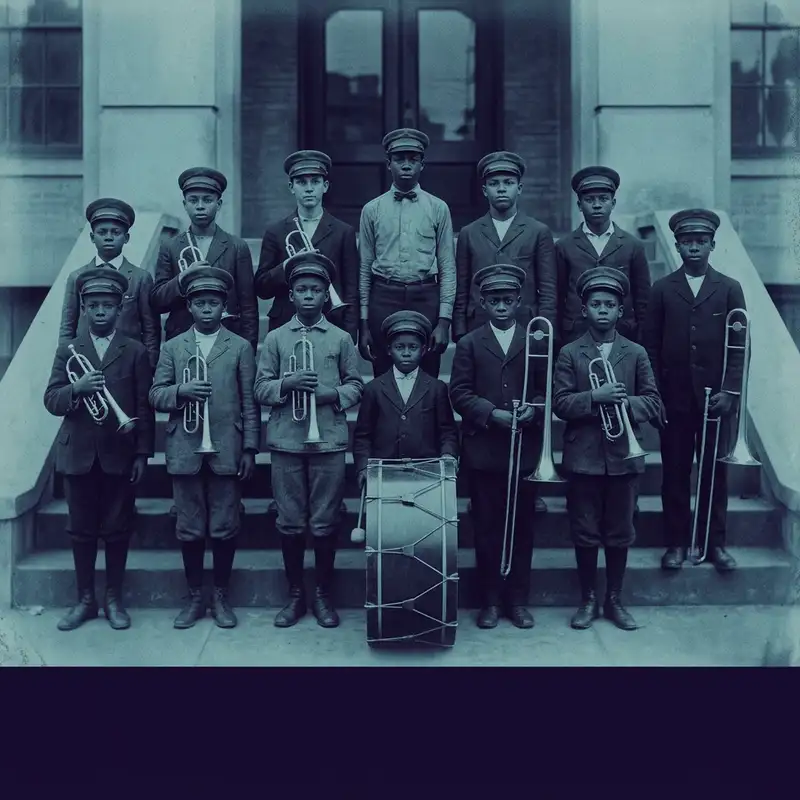
Thomas Stubbs:Spare food, no mattresses, corporal discipline. But the home had a brass band, and the band had a director named Peter Davis. And Davis saw what the Karnovsky's had seen. He started Armstrong on tambourine, moved him to drums, then bugle, then cornet. Within six months, Armstrong was leading the band.
Thomas Stubbs:He was released after about eighteen months. He was 14. He played wherever he could, honky tonks, fish fries, funeral parades, the rough joints along Perdido Street. He idolized Joe King Oliver, the best cornetist in the city, and he made himself useful, hanging around Oliver's house doing chores for Oliver's wife Stella, absorbing everything the older man would teach him. When Oliver left New Orleans for Chicago in 1918, he recommended little Louis to kid Orey as his replacement.
Thomas Stubbs:Armstrong was 17. He stepped into the chair of the best cornetist in New Orleans and filled it. In 1922, King Oliver sent for him, come to Chicago, play in my band. Armstrong was 21 years old. He had a horn and a reputation and four years of professional experience in a city that produced musicians the way the river produced catfish, constantly, abundantly, in conditions that were not kind to the things they produced.
Thomas Stubbs:He took the Illinois Central, the same route hundreds of black southerners were traveling during the Great Migration. He arrived at the Illinois Central Terminal on 12th Street on the South Side Of Chicago. He walked into the Lincoln Gardens Ballroom and set down for Joe Oliver, and he played second cornet in King Oliver's Creole jazz band. Within months, everyone in Chicago knew. Within a year, he was outplaying Oliver.
Thomas Stubbs:He was outplaying everyone. He could blow 200 high seas in a row. He could swing harder than any musician alive. He could make a trumpet sound like a human voice and a human voice sound like a trumpet. And he did both with joy and generosity that made other musicians wanna quit their instruments or dedicate their lives to catching up.
Thomas Stubbs:He didn't just play differently. He changed what the music was. The hot five and hot seven recordings he made in Chicago between 1925 and 1928 are the hinge point of twentieth century American music. The moment when jazz stopped being a regional folk tradition and became an art form with a single towering figure at its center. And that figure was a kid from the battlefield who had bought a $5 cornet from a pawn shop with money advanced by a Lithuanian Jewish junk dealer.
Thomas Stubbs:This has been Groundwater, episode two, Little Louis. I'm Thomas Stubbs. The book this episode draws from is called race records, the lie that split American music and the blues that ran underneath. Next episode, professor Long Hare kicking the bass of his piano, the meters inventing funk on Valens Street, a jazz funeral, the levees breaking, and a British rock star on his knees in a Chicago recording studio arriving at the source of everything. The drain runs in reverse.
Thomas Stubbs:Thank you for listening.