Twelfth Street Station: The Great Migration and How New Orleans Music Reached Chicago
Download MP3The romantic story says the music traveled north on riverboats. Paddle steamers on the Mississippi, a ragtime band playing the promenade deck. The music drifting north on the current towards civilization. It's a beautiful story. It's mostly wrong.
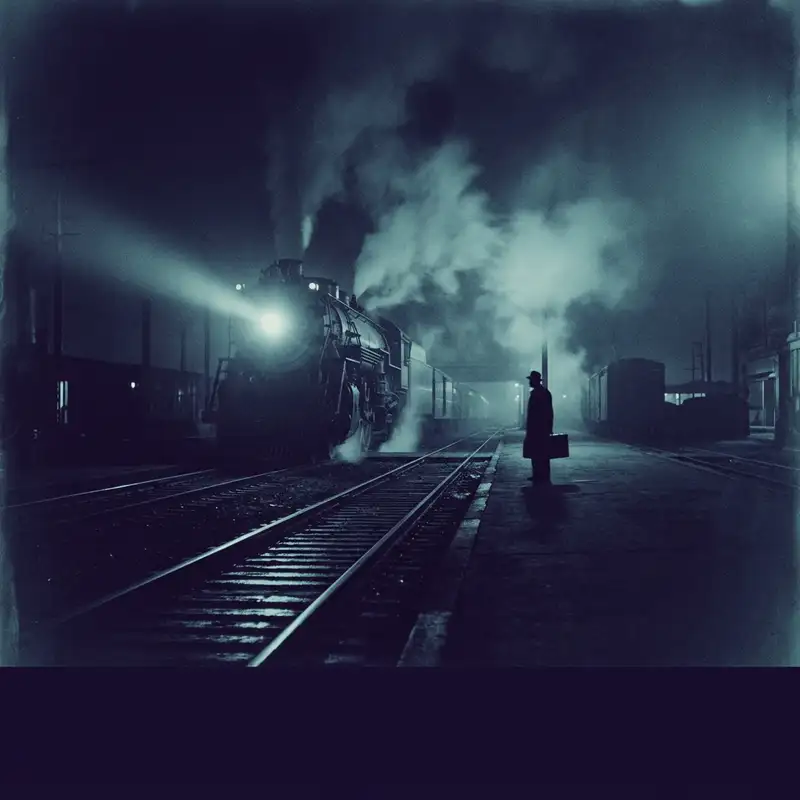
Thomas Stubbs:The music traveled north on the Illinois Central Railroad. It traveled in the luggage cars and the Jim Crow coaches alongside hundreds of thousands of black southerners leaving the Deep South in the largest internal migration in American history. They were not drifting. They were fleeing. This is Groundwater.
Thomas Stubbs:I'm Thomas Stubbs. Episode four, 12th Street Station. The last three episodes were New Orleans, the city where the music started, the Sunday exception at Congo Square, Louis Armstrong coming up out of it, the second line in the flood. This episode is about what happened when it left. The Illinois Central Railroad, the great migration, a kid from New Orleans stepping off the train in Chicago in 1922, and thirteen seconds of unaccompanied trumpet.
Thomas Stubbs:Act one, the train north. Between 1910 and 1970, 6,000,000 black southerners left the Deep South for the industrial cities of the North. They left behind sharecropping arrangements designed to guarantee permanent debt. They left behind vagrancy laws that could put a black man on a chain gang for the crime of not having a documented employment on any given Tuesday. They left behind the daily arithmetic of a violence the law would not only permit, but sometimes organize.
Thomas Stubbs:Economists who studied this migration found that one variable predicted it better than almost anything else. The proximity of a railroad line to your place of birth. The closer you live to the tracks, the more likely you were to leave. The Illinois Central ran from New Orleans straight through the heart of Mississippi into Chicago with stops that functioned as relay stations in a cultural telegraph. Jackson, Memphis, Cairo, Champaign, each one receiving the signal and passing in further north.
Thomas Stubbs:The musicians went with everyone else for the same reasons. Chicago was booming. The South Side was booming louder. By 1920, the black population of Chicago had more than doubled in a decade. The Stroll, a stretch of State Street between 26th And 39th, was lined with nightclubs, dance halls, theaters, and cabarets that needed musicians the way the stockyards needed workers.
Thomas Stubbs:King Oliver came to Chicago in 1918, established himself at the Lincoln Gardens with a Creole jazz band, brought the New Orleans sound north intact, immediate, alive. He wasn't bringing the music into an empty room. Chicago had been a black music city before New Orleans players arrived. Mississippi Delta Blues were coming up directly with the great migration, different route, same destination. Jimmy Yancey was playing boogie woogie piano at rent parties on the South Side.
Thomas Stubbs:The South Side churches were already a gospel scene. Mahalia Jackson would arrive at New Orleans in 1927 and join it. Kansas City swing was developing in parallel, two states west. East Coast stride had its own city. The New Orleans sound landed in a room that was already playing.
Thomas Stubbs:Then King Oliver sent for Louis. King Oliver's Creole jazz band chimes blues, Guinness Records, 04/05/1923. The cornet solo on this record, two twelve bar choruses late in the track is Louis Armstrong's first recorded solo. He was 21 years old. Armstrong had arrived at the Illinois Central Terminal at 12th Street in the summer of nineteen twenty two carrying a cornet and a fish sandwich his mother had packed for the trip.
Thomas Stubbs:He walked into the Lincoln Gardens and sat down next to King Oliver and played second cornet. And within months, the word was spreading from Chicago to New York to the East Coast. This kid from New Orleans was something that had not been heard before. What happened in Chicago over the next six years changed what music was. Armstrong left Oliver in 1924, played briefly with Fletcher Henderson in New York, returned to Chicago, made the records that broke the world open.
Thomas Stubbs:The hot fives and hot seven sessions recorded for okay records between 1925 and 1928 are the hinge point. West End Blues opens with an unaccompanied trumpet cadenza thirteen seconds just Armstrong and the horn. Before that cadenza, jazz was a conversation among equals. The ensemble carried the music, individual voices contributed to the whole. After it, there was a soloist and a band and a tradition of individual expression inside a collective form that would define jazz and eventually rock and roll and hip hop for the rest of the century.
Thomas Stubbs:West End Blues, Louis Armstrong and his hot five okay records recorded 06/28/1928 in Chicago. Thirteen seconds. That opening cadenza unaccompanied starting low climbing through an interval that felt discovered rather than composed landing somewhere in the upper register that felt like air, was heard by people who had never imagined a trumpet could do that. It was heard in New York. It was heard in London.
Thomas Stubbs:It was heard in Paris. And before long, the records reached a Romani guitarist in Belgium with two damaged fingers on his fretting hand who would spend the rest of his life trying to do with a guitar what Armstrong had done with a horn. But that's the next episode. The great migration also brought the blues North. Delta musicians from Mississippi following the same tracks, electrifying their acoustic guitars when they arrived in Chicago because the clubs on the South Side were too loud for an unamplified instrument.
Thomas Stubbs:Muddy Waters came up from Clarksdale in 1943. Hall and Wolf from West Point, Mississippi via Memphis. The Polish Jewish immigrant brothers Leonard and Phil Chess recorded them at their studio on the South Michigan Avenue. Muddy Waters, Hoochie Coochie Man, Chess Records, 01/07/1954, written by Willie Dixon, recorded on the South Side Of Chicago.
Thomas Stubbs:The gypsy woman told my mother before I was born, I got a boy charge coming. He's gonna be a son of a gun. He gonna make pretty women's.
Thomas Stubbs:The acoustic guitar he'd carry up from Mississippi was gone. The clubs were too loud. What's left is the same Delta Blues Robert Johnson recorded in a San Antonio hotel room in 1936. Amplified, Electrified, recorded by two immigrant brothers from Poland who figured out that the South Side Of Chicago was where American music was being made. Chess Records is the northern terminus of a pipeline that starts in Congo Square.
Thomas Stubbs:Act two of the corridor. The music did not travel in a straight line from New Orleans to Chicago. It stopped along the way, and every place it stopped, it became something else. Memphis was the first relay station. Beale Street had been drawing musicians from the surrounding Delta since the eighteen nineties.
Thomas Stubbs:The city sat at the intersection of the river and the railroad, the right location at the right moment. WC Handy arrived in Memphis in nineteen o nine. He was a band leader from Alabama who had spent years playing dances across the South. He had heard something in the streets, a specific blues tonality, a 12 bar structure that seemed to recur independently across different musicians in different towns. They didn't have a name for yet.
Thomas Stubbs:He published Memphis Blues in 1912, Saint Louis Blues in 1914. Handy didn't invent the blues. He was a trained musician who recognized what was already in the air and transcribed it into a form that could be sold. The gap between the thing itself and the person who figured out how to sell it has shaped the economics of American music ever since. Kansas City, under the political machine of Tom Pendergast, was a city where prohibition was a polite fiction.
Thomas Stubbs:The clubs never closed, and the musicians played all night because there was always another after hours joint that needed a band. The result was a hothouse, a style distinct from both New Orleans and New York. Hard swinging blues drenched built on riff based compositions and competitive jan sessions that could last until dawn. Count Basie distilled it to its essence. Count Basie and his orchestra, 01:00 jump, Dekker records, 1937.
Thomas Stubbs:The band built it on the bandstand at the Reno Club out of riffs with nothing written down. The name came from a radio broadcast that ran close to one in the morning. He played it the rest of his life. From Kansas City, Charlie Parker emerged. What Parker and Dizzy Gillespie and Felonious Monk invented in the nineteen forties was a revolution disguised as a music lesson.
Thomas Stubbs:They made the music too fast to dance to, too harmonically complex for the swing band arrangers to steal, too demanding for anyone who hadn't put in years of practice to even follow, much less imitate. This was not an accident. Beneath Goodman had become the king of swing by hiring black arranger Fletcher Henderson to write charts for a white band that could get the bookings Henderson's own band couldn't. The swap was legal, common, and well understood by everybody involved. The beboppers closed that window deliberately.
Thomas Stubbs:You want to steal bebop, you have to be able to play it, and almost nobody could. Charlie Parker and Dizzy Gillespie, Coco, Savoy Records, 11/26/1945. Parker improvises over the chord changes to Cherokee at a tempo most musicians of the era couldn't follow. That's the point. The Illinois Central had delivered the blues to Chicago.
Thomas Stubbs:The corridor from Memphis to Kansas City had concentrated and transformed it. By 1945, what had started in Congo Square and traveled north in a Jim Crow railroad car had become something so technically demanding that the best musicians in the world had to sit with it for years before they could approach it. But the Illinois Central wasn't the only line running. The same route system, the same West African rhythmic memory, the same diaspora was also moving East and South and across the water and directions that had nothing to do with the tracks between New Orleans and Chicago. Across the Atlantic, to Havana, to Paris, to Rio.
Thomas Stubbs:The mouth of the river had more than one opening. This has been Groundwater episode four, 12th Street Station. I'm Thomas Stubbs. The book this episode draws from is called Race Records, The Lie That Split American Music and the Blues That Ran Underneath. Next episode, the cousins meet in a Manhattan nightclub.
Thomas Stubbs:A Romani guitarist with two fingers plays jazz through the occupation of Paris, and a 22 year old who had never recorded before accidentally becomes the voice of Bossa Nova. The drain runs in every direction. Thank you for listening.