The Drain: New Orleans Music From Professor Longhair to Katrina
Download MP3Professor Longhair kicked the bass of his piano to keep time. The Meters stripped the second line down to funk. Then the levees broke. New Orleans music from Longhair to Katrina
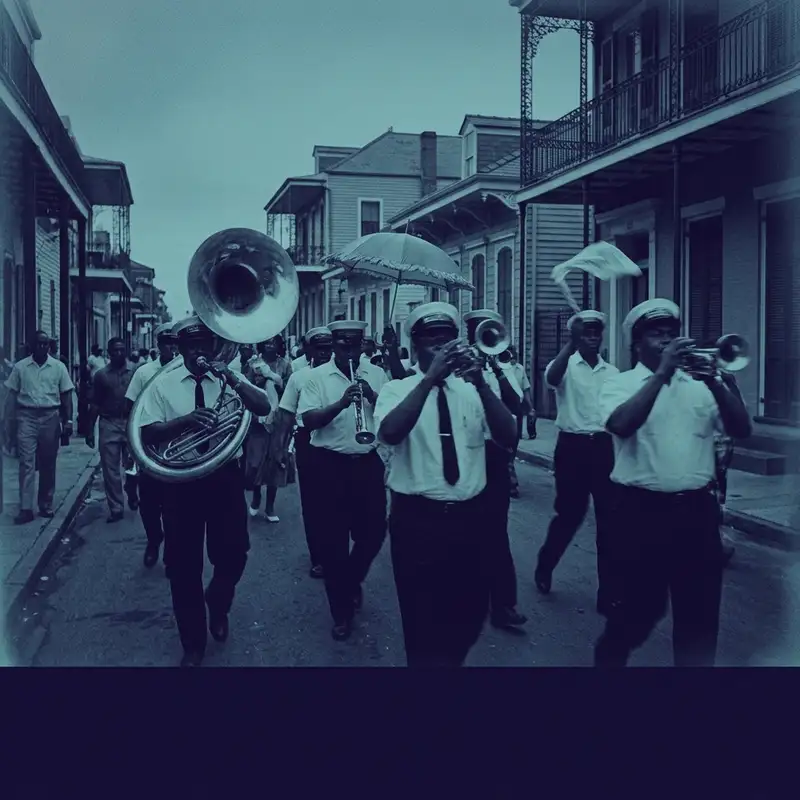
Armstrong left. Bechet left. Oliver left. Morton left. For thirty years, the romantic version of the story held that New Orleans jazz had migrated north and the city was living on memory. It was wrong. The city never stopped cooking.
This episode traces the music that stayed: Professor Longhair’s rumba-boogie on a piano with several keys missing; Fats Domino selling sixty-five million records without leaving the Ninth Ward; the Meters inventing funk on Valence Street; the second-line beat and the jazz funeral as direct descendants of Congo Square; bounce as the rhythmic line running from a Magnolia housing project in 1991 back to an enslaved man on a drum in 1819. On August 29, 2005, the levees broke, and the people displaced were precisely the people who carried the tradition. Some came back. Many came back. The second lines resumed.
The episode closes on Keith Richards on his knees at Chess Records — the drain running in reverse.
Adapted from *Race Records: The Lie That Split American Music — and the Blues That Ran Underneath* (forthcoming).
-----
**Music featured in this episode:**
“Go to the Mardi Gras” — Professor Longhair (Ron Records, 1959)
“Tipitina” — Professor Longhair (Atlantic, 1953)
“Blueberry Hill” — Fats Domino (Imperial, 1956)
“Cissy Strut” — The Meters (Josie Records, 1969)
“Brass Band Beat No. 1,” from *New Orleans Brass Band Beats: Second Line Season, Vol. 1*
“Just a Closer Walk With Thee” and “New Second Line” — Olympia Brass Band, from *New Orleans Funeral and Parade* (Folkways Records, 1962)
“Brother John” — The Wild Tchoupitoulas (Island/Antilles, 1976)
“Get It Ready Ready” — DJ Jubilee (Take Fo’ Records, 1993)
“Let Me Get That Outcha” — Big Freedia
“Walter’s Blues” (live) — Little Walter, with Hound Dog Taylor (guitar), Dillard Crume (bass), and Odie Payne (drums)
“I Can’t Be Satisfied” — Muddy Waters (Aristocrat, 1948)
Theme music: “Guitar Rag” — Sylvester Weaver (OKeh, 1923; public domain).
All excerpts used under fair-use claim for purposes of criticism and commentary.
Armstrong left. Bechet left. Oliver left. Morton left. For thirty years, the romantic version of the story held that New Orleans jazz had migrated north and the city was living on memory. It was wrong. The city never stopped cooking.
This episode traces the music that stayed: Professor Longhair’s rumba-boogie on a piano with several keys missing; Fats Domino selling sixty-five million records without leaving the Ninth Ward; the Meters inventing funk on Valence Street; the second-line beat and the jazz funeral as direct descendants of Congo Square; bounce as the rhythmic line running from a Magnolia housing project in 1991 back to an enslaved man on a drum in 1819. On August 29, 2005, the levees broke, and the people displaced were precisely the people who carried the tradition. Some came back. Many came back. The second lines resumed.
The episode closes on Keith Richards on his knees at Chess Records — the drain running in reverse.
Adapted from *Race Records: The Lie That Split American Music — and the Blues That Ran Underneath* (forthcoming).
-----
**Music featured in this episode:**
“Go to the Mardi Gras” — Professor Longhair (Ron Records, 1959)
“Tipitina” — Professor Longhair (Atlantic, 1953)
“Blueberry Hill” — Fats Domino (Imperial, 1956)
“Cissy Strut” — The Meters (Josie Records, 1969)
“Brass Band Beat No. 1,” from *New Orleans Brass Band Beats: Second Line Season, Vol. 1*
“Just a Closer Walk With Thee” and “New Second Line” — Olympia Brass Band, from *New Orleans Funeral and Parade* (Folkways Records, 1962)
“Brother John” — The Wild Tchoupitoulas (Island/Antilles, 1976)
“Get It Ready Ready” — DJ Jubilee (Take Fo’ Records, 1993)
“Let Me Get That Outcha” — Big Freedia
“Walter’s Blues” (live) — Little Walter, with Hound Dog Taylor (guitar), Dillard Crume (bass), and Odie Payne (drums)
“I Can’t Be Satisfied” — Muddy Waters (Aristocrat, 1948)
Theme music: “Guitar Rag” — Sylvester Weaver (OKeh, 1923; public domain).
All excerpts used under fair-use claim for purposes of criticism and commentary.