The Drain: New Orleans Music From Professor Longhair to Katrina
Download MP3Armstrong left. Bechet left. Oliver left. Morton left. The best musicians New Orleans produced kept leaving because the money was in Chicago and New York, and the racism was slightly less lethal. And for 30 years, the romantic version of the story held that New Orleans jazz had migrated north, and the city was living on memory.
The romantic version was wrong. The city never stopped cooking.
This is Groundwater. I’m Thomas Stubbs. Episode three, “The Drain.” The last of the three episodes about New Orleans. We’ve been to the swamp where the city was founded, and to Congo Square, where the beat survived, and to Storyville, where the music professionalized, and to a kid from the battlefield who left for Chicago and changed what music was.
Today, what stayed. A piano in Bogalusa with several missing keys, a jazz funeral, the levees breaking, and a British rock star on his knees in a Chicago recording studio arriving at the source of everything. The drain runs in reverse.
The professors. What happened after the first generation scattered was that the music went deeper into the neighborhoods. It stopped being jazz or stopped being called jazz and became rhythm and blues and then funk, and then something that didn’t have a name yet, but sounded like nothing on Earth. The through line was the piano.
Henry Roeland Byrd. Professor Longhair. Fess. Born in Bogalusa in 1918, moved to New Orleans as an infant. He reportedly learned to play on a piano missing several keys, which may explain the eccentric technique. He kept time by kicking the base of the instrument with his foot, and his left hand did things that no other left hand in American music was doing.
What Fess played was a rumba boogie. Afro-Cuban clave patterns fused with barrelhouse blues. The rhythmic inheritance of Congo Square passed through a century of second line parades and reassembled on the keyboard. He had one national hit, “Baldhead,” in 1950. He never had another. He was too strange for the mainstream.
But every pianist who came after him in New Orleans understood that Fess was the source. Fats Domino heard it. Allen Toussaint heard it. Art Neville heard it. James Booker heard it. Dr. John heard it. By the 1960s, Longhair had disappeared from the music scene so thoroughly that people assumed he was dead.
He was alive. He was sweeping floors. In 1971, he was invited to perform at the first New Orleans Jazz and Heritage Festival, and the career resurrected. Tipitina’s, the nightclub that became the epicenter of New Orleans music revival in the late 1970s, was named after one of his songs.
He died on January 30, 1980, just as the world was catching up to what the city had known for thirty years.
Antoine “Fats” Domino heard Longhair and simplified. He sold sixty-five million records, second only to Elvis Presley in the decade, and he did it without leaving the Ninth Ward. He lived in the same pink house in the Lower Nine for the rest of his life.
When Hurricane Katrina hit in 2005, Domino had to be rescued by boat from that house. He was eighty. He rebuilt and stayed.
Allen Toussaint was the architect behind the scenes, the songwriter, arranger, and producer who shaped the New Orleans sound from the late 1950s through the 1970s. “Working in the Coal Mine.” “Mother-in-Law.” “Southern Nights.” Labelle’s “Lady Marmalade.” He never became a household name outside the city. He didn’t need to.
On Valence Street, the Neville family kept an upright piano. Art Neville learned on it. James Booker, the most technically brilliant and self-destructive pianist in the city’s history, came through and held court on it. And a kid named Joseph “Zigaboo” Modeliste, five or six years old, would come by when he heard the drums and press his forehead against the screen door to listen to Art’s band rehearse. When he walked away, the screen door pattern was imprinted on his skin.
Modeliste grew up to join Art Neville, bassist George Porter Jr., and guitarist Leo Nocentelli to form The Meters. And The Meters invented funk. Or reinvented it. They took the second line beat that had been marching through New Orleans streets for a hundred years and plugged it into amplifiers, stripped it down to its rhythmic skeleton, made it so lean and hard and precise that James Brown heard it and went further.
Parliament heard Brown and went further. And hip-hop heard Parliament. The whole tree grew from a root that started in a shotgun house on Valence Street.
Mac Rebennack. Dr. John. White kid from the Third Ward who was playing guitar on Professor Longhair recording sessions before he was old enough to drive. He met Fess at 13. From that point forward, the racial line that supposedly divided the New Orleans music scene was, for Rebennack, irrelevant. He played with anybody who could play. In L.A., scuffling on session work, he grabbed unused studio time with fellow New Orleans exile Harold Battiste and made Gris-Gris, credited to Dr. John, the Night Tripper, a persona based on a real 19th century New Orleans voodoo doctor. It sounded more like New Orleans than anything recorded in the actual city at the time.
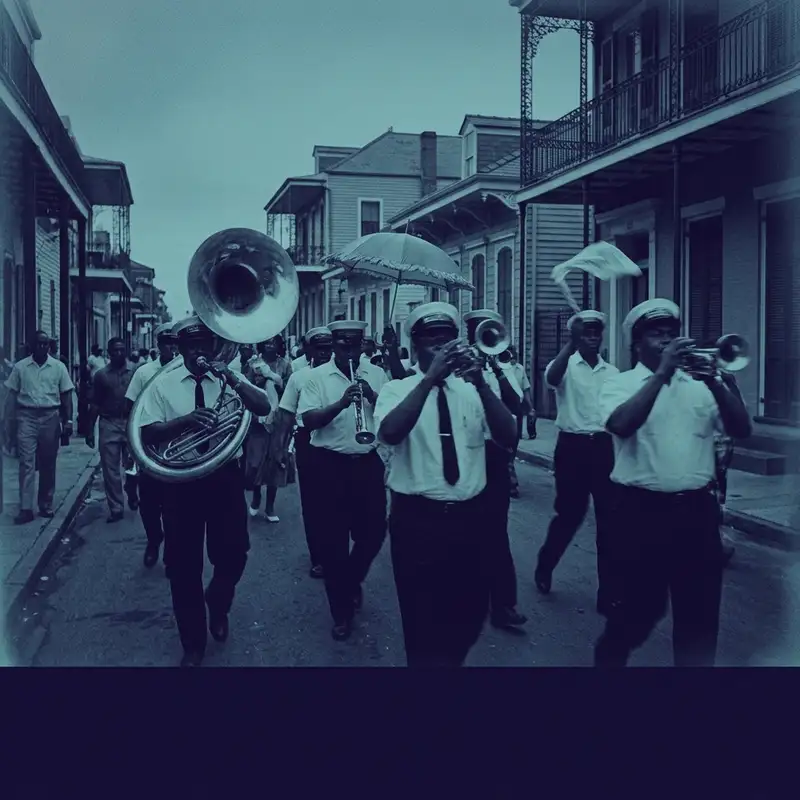
Every Sunday in New Orleans, somebody is parading. Not the tourist parades. The real parades. Organized by social aid and pleasure clubs with names like the Prince of Wales, the Young Men Olympian Junior Benevolent Association, founded in 1884, still parading, the Pigeon Town Steppers, the Nine Times, the Original Big Seven.
A grand marshal in a suit so sharp it could cut glass leads the way, carrying a decorated parasol. A brass band falls in behind him. And then the second line forms. The mass of people who follow the band, uninvited and completely expected, shaking handkerchiefs and dancing in a style that belongs to New Orleans and nowhere else. A full-body response to a beat that has been marching through these streets for longer than anyone alive can remember.
The second line is the direct descendant of Congo Square. The social aid and pleasure clubs that formed after emancipation to provide insurance, burial costs, and community to Black New Orleanians who could get none of these from the white power structure, they paraded to advertise themselves. The parades drew followers. The followers became the second line.
The brass bands played a syncopated march rooted in West African polyrhythm. The second line dancers added their own rhythms on top. Chants, footwork, the rhythmic hiccup that makes your shoulders drop and your feet move before your brain has processed what happened. That accent is the foundation of New Orleans jazz. It is the foundation of New Orleans R&B. It is the foundation of funk. It is three hundred years old.
The jazz funeral is the second line’s most sacred form. The first line marches to the cemetery playing dirges and hymns, slow and solemn. “Just a Closer Walk with Thee.” “Amazing Grace.” The weight of death sits on the music like humidity. Then the body is committed to the ground. The band waits until the procession is a respectable distance from the sacred space, and then something happens.
The snare drummer hits a roll. The tuba player drops a note. The trumpet opens up. And the dirge detonates into joy, up-tempo, raucous, ecstatic. A celebration of the life that was lived and the lives that continue. The second line falls in behind the band. The handkerchiefs come out. The dancing starts.
Somebody is dead. Everybody else is still here, and the only proper response to that fact is to play so loud that the dead can hear you on the other side. It is an African tradition surviving in plain sight. It is the most honest thing Americans do with death.
The Mardi Gras Indians are even older. Black men who spend the entire year hand-sewing elaborate suits and beads and feathers and rhinestones that weigh fifty, sixty, eighty pounds and cost thousands of dollars. Suits so intricate and so beautiful that they constitute one of the great folk art traditions in the world. On Mardi Gras Day and St. Joseph’s Day and Super Sunday, the tribes come out. The Wild Magnolias, the Wild Tchoupitoulas, the Golden Eagles, the Mohawk Hunters, and they parade through their neighborhoods in full regalia, chanting call-and-response songs that fuse West African polyrhythm with Choctaw and Chickasaw linguistic fragments and Louisiana Creole and French. “Iko Iko.” “Jock-A-Mo.” “Indian Red.”
The tradition developed from the encounter between enslaved Africans and the indigenous peoples of Louisiana, who sheltered runaways and shared survival skills in the swamps and bayous around the city. It is a masquerade tradition rooted in West African ceremony. The Mardi Gras Indians do not parade for tourists. They parade for each other.
On August 29, 2005, the levees broke. The Lower Ninth Ward went underwater. The Tremé flooded. More than 1,800 people died. And the people who were displaced were precisely the people who carried the tradition. The second line dancers, the Mardi Gras Indian tribes, the brass band players.
Some came back. Many came back. The Rebirth Brass Band came back. The Preservation Hall Jazz Band never left. Second lines resumed, tentatively, then defiantly, then with the ferocity of people who understood that if they stopped parading, something irreplaceable would die. But the city that came back was not the same city that went under. Gentrification followed the flood. The Tremé, which had been a Black neighborhood since before the Louisiana Purchase, began to fill with newcomers who loved the culture and could outbid the people who created it.
Then there was bounce. In the late 1980s and early 1990s, in the housing projects and block parties of New Orleans, a local strain of hip-hop emerged that sounded like nothing coming out of New York or Los Angeles. Built on call-and-response chants and a beat sampled from a 1986 New York track, the Triggerman beat. But what the New Orleans producers and MCs did with that sample was unmistakably local. The tempo was up-tempo. The chants were participatory. The energy was second line. The rhythmic DNA was three hundred years old.
DJ Jubilee. DJ Jimi. Cheeky Blakk. MC T. Tucker. They built something that was simultaneously the newest music in the city and the oldest, because the call-and-response structure came from Congo Square, and the dancing came from the second line, and the competition between neighborhoods came from the Mardi Gras Indian tradition.
Bounce also carried forward something the city had always known. New Orleans has a long tradition of gay and cross-dressing performers as a genuine part of its musical culture. Big Freedia, Katey Red, Sissy Nobby — they were part of a lineage that included the drag performers of the French Quarter, the gender-fluid traditions of Mardi Gras, and the fundamental New Orleans principle that what you do with your body on a dance floor is between you and the beat, and nobody else gets a vote.
The Mississippi River does not know what it is carrying. It collects rain from Montana and runoff from Ohio and topsoil from Iowa and carries all of it south without preference or discrimination, depositing everything at the bottom in a city that exists because somebody needed to stand at the mouth and collect the tolls.
But the drain runs in reverse. Everything flowed down. Cotton, timber, people, money, suffering. Culture flowed back up. The bamboula rhythm that survived in Congo Square became the second line beat. The second line beat became Professor Longhair’s left hand. Longhair’s left hand became the Meters’ groove. The Meters’ groove became the foundation of funk.
Funk became the rhythmic basis of hip-hop. A straight line from an enslaved man sitting astride a drum in 1819 to a producer sampling the Triggerman beat in a Magnolia housing project in 1991.
Armstrong carried it to Chicago. Oliver carried it to Chicago. Bechet carried it to Paris. Morton carried it everywhere and told everyone he had invented it. The music left the city the way the river leaves the continent, through the mouth, into the open water, unstoppable. It reached Memphis and became the blues electrified. It reached Kansas City and became the swing that Basie counted off. It reached Chicago and became the thing that made the South Side jump on Saturday nights. It reached New York and became bebop and hard bop and free jazz and everything that followed. It reached London and came back as the Rolling Stones and the Beatles. White boys who had heard the records and followed the sound back to its source the way salmon follow the current home.
Keith Richards on his knees at Chess Records. The drain running in reverse.
And in New Orleans, the pot never came off the heat. Nobody left in charge of the stove. The city just kept producing. Bolden. Morton. Oliver. Armstrong. Bechet. Longhair. Domino. Toussaint. The Nevilles. The Meters. Dr. John. The Dirty Dozen. Rebirth. Trombone Shorty. Big Freedia.
An unbroken line of musicians who sound like nothing else because they come from a place that is like nothing else.
The city is still sinking. The river is still rising. The levees are holding. For now. And somewhere in a neighborhood that doesn’t appear in the guidebooks, on a Sunday afternoon that nobody has scheduled or promoted or live-streamed, a brass band is tuning up. A grand marshal is adjusting his hat. The second line is forming behind the band. The beat that started in Congo Square 300 years ago is about to hit the street again.
Because the mouth of the river has been singing since before anyone thought to call it music.
This has been Groundwater. Episode three, “The Drain.” I’m Thomas Stubbs. The book this episode draws from is called Race Records: The Lie That Split American Music — and the Blues That Ran Underneath. That completes our three-episode arc on New Orleans. Next time, we leave the city. The Illinois Central. Memphis. Kansas City. Chicago. The export routes that carried this music north.
Thank you for listening.