We Both Speak African: Dizzy Gillespie, Miles Davis, and How Jazz Crossed the Atlantic
Download MP3Groundwater — Episode 5: We Both Speak African: Jazz Crosses the Atlantic
===
[00:00:00]
Chano at Carnegie Hall
---
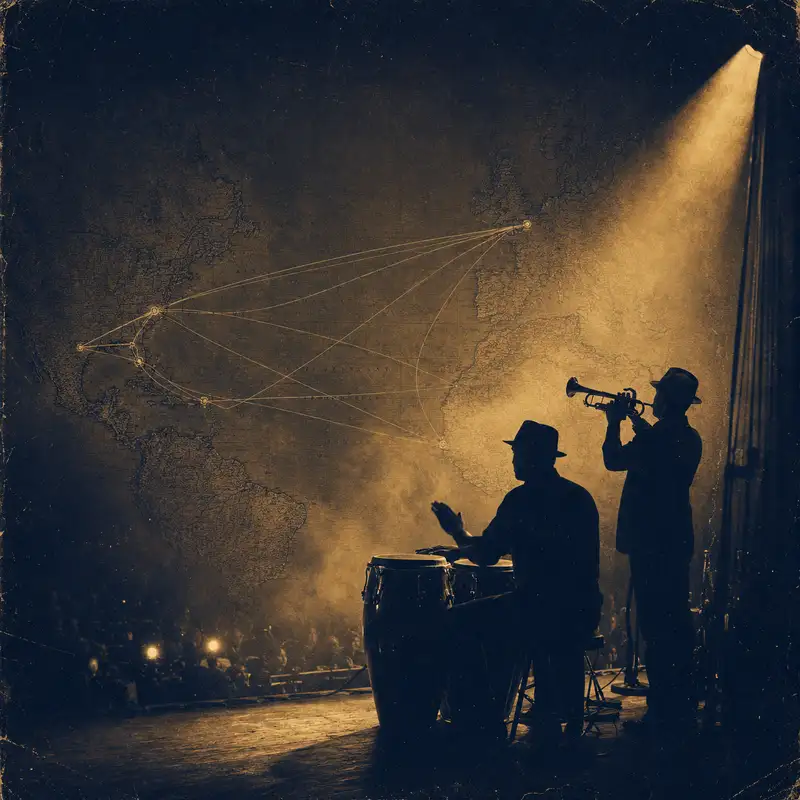
Speaker: In 1947, a percussionist named Luciano Pozo González walked onto the stage at Carnegie Hall in New York City He had grown up in a former slave quarters in Havana called El Africa Solar. He had dropped out of school after third grade. He was a practitioner of Santeria whose knowledge of the sacred Abakua rhythms ran deeper than any conservatory could teach.
Everyone called him Chano. He was 32 years old. He had been in New York for less than two years. When he played that night in Carnegie Hall, he brought the West African rhythmic tradition into the most prestigious concert hall in the United States. And the musicians on stage with him heard something they already knew
[00:01:00]
Episode Map and Theme
---
Speaker: This is Groundwater. I'm Thomas Stubbs. Episode five: We Both Speak African Last episode traced the music north up the Illinois Central from New Orleans to Chicago into bebop, into the Chess Record studio on South Michigan Avenue.
This episode traces it outward across the water to Havana, across the Atlantic to Paris, south across the equator to Rio de Janeiro, and back across the ocean to a recording studio in New York, where Miles Davis heard something in a Spanish guitar concerto that he already knew from the blues coming up the river in East St.
Louis
The drain runs in every direction
Spanish Tinge and Clave
---
Speaker: Act one: The family reunion Jelly Roll Morton named it in the 1930s, the Spanish tinge. An [00:02:00] Afro-Cuban rhythmic undertow he said was essential to jazz. "Without it," he said, "you had something else. With it, you had New Orleans music." He wasn't talking about Spain. He was talking about Cuba. And what he was describing without quite having the vocabulary for it was something that had happened on the west coast of Africa centuries earlier
The same West African rhythmic traditions that survived in Congo Square had also survived in Havana. Same source, different colonial pot. Three centuries later, the cousins met in a Manhattan nightclub and recognized each other immediately The man who engineered the reunion was Mario Balza Bauza was born in Havana in 1911, arrived in New York in 1930, and [00:03:00] methodically worked his way through the jazz world.
He played lead trumpet for Chick Webb, bringing in Ella Fitzgerald while he was at it. He played with Cab Calloway and talked Calloway into hiring a young trumpet player named Dizzy Gillespie In 1941, Bauza became the music director of his brother-in-law's band, Machito and His Afro Cubans. What that band did was take the clave rhythm, the two-bar pattern that organizes virtually all Afro Cuban music, the heartbeat underneath everything, and make it the explicit foundation of a jazz ensemble
Then Baozu found the catalyst you needed Jano Pozo His mother died when he was 11. The rhythms he carried, the sacred Abakuá traditions had survived the Middle Passage in Cuba the way Bamboula drumming had survived it in Congo [00:04:00] Square He arrived in New York in 1946. Within months, he and Dizzy Gillespie were playing together.
Their debut came at Carnegie Hall on September 29th, 1947. Pozo spoke almost no English. Gillespie spoke no Spanish. Asked how the two of them communicated, Pozo had the answer ready.
Manteca and the Handshake
---
Speaker: "We both speak African." The partnership lasted 13 months Three months after Carnegie Hall, on December 30th, 1947, they recorded Manteca, co-written by Gillespie, Pozo, and arranger Gil Fuller.
Pozo came to Gillespie with the riffs already worked out. The bass line, the saxophone parts, the trombone parts, the trumpet parts, all layered, contrapuntal ostinatos in the Afro-Cuban tradition. [00:05:00] Gillespie wrote the bridge, 16 bars of bebop harmony. Manteca, Dizzy Gillespie and his orchestra featuring Chano Pozo on conga.
Victor Records, December 30th, 1947. The opening vamp is Pozo, Afro-Cuban clave patterns, the West African root. Then the bridge arrives, 16 bars of bebop harmony. That seam right in the middle, that's where the cousins shake hands.
[00:06:00]
Pozo Legacy and Loss
---
Speaker: Chano Pozo was shot and killed in a Harlem bar on December 2nd, 1948 He was 33 years old.
The dispute was over bad marijuana. In 13 months, he changed how American jazz keeps time. He left behind a handful of recordings and a door that never closed
Act two. The Hot Club
Django Finds Jazz
---
Speaker: Jean-Baptiste "Django" Reinhardt was born in 1910 in Belgium into a family of Manouche, the French Sinti, a Romani people who had been moving through Western Europe for centuries. His father played violin. His mother played banjo guitar. Django was playing at the level [00:07:00] of a professional by the time he was twelve.
Around 1931, a painter named Emile Savitry played Django some records from his collection. Louis Armstrong, Duke Ellington, Joe Venuti, Eddie Lang. Django heard Armstrong and everything shifted. The improvisational freedom, the rhythmic swing, the idea that a solo instrument could carry the emotional weight of an entire performance.
These were things that the Romani musical tradition had always valued. It was not conversion. It was recognition
But there was the fire. In 1928, before the Armstrong revelation, a fire broke out in Django's caravan. His right leg was damaged permanently, and two fingers on his left hand, the ring finger and the little finger of his fretting hand, were fused together and rendered useless.[00:08:00]
For a guitarist, that is the end
After 18 months of recovery, Jenga reinvented guitar technique from scratch. Single note solos using only his index and middle fingers. The chord voicings he developed, born of physical necessity, impossible any other way, became the harmonic vocabulary of an entire genre
Hot Club and Wartime Paris
---
Speaker: In 1934, the Quintet du Hot Club de France was born. Django on lead guitar, Stéphane Grappelli on violin, two rhythm guitars, and a double bass. All strings, no percussions. The rhythm came from the guitars themselves, a percussive strumming technique called la pompe
Speaker: Jango Reinhardt and the Quintet du Hot Club de France, Minor Swing, Swing Records, 1937. The rhythm guitar underneath is a la pompe, the percussive strumming technique [00:09:00] Jango's physical limitations forced him to develop. No drums, all the swing comes from the strings
Speaker: When Germany occupied France in 1940, Django was a Romani jazz musician in a country controlled by people who were systematically exterminating both Romani people and jazz.
He composed Nuages, Clouds, which became an unofficial anthem of the French Resistance. He didn't write [00:10:00] protest songs. He played jazz, the music the occupiers had declared degenerate as a member of the race they had declared subhuman in the capital of the country they had conquered night after night until the occupation ended On May sixteenth, nineteen fifty-three, Jengo Reinhardt suffered a brain hemorrhage and died.
He was forty-three years old The music of New Orleans carried across the Atlantic on shellac had fused with the music of a nomadic people who had been carrying their own tradition across Europe for centuries. What came out of that collision, cooked under conditions of poverty and injury and occupation, was something new and irreversible.
Act three.
Rio and Bossa Roots
---
Speaker: The girl from Ipanema. The train ran south too Across the equator to another port city built on the labor of enslaved [00:11:00] Africans, surrounded by water, drenched in heat, Catholic carnival-celebrating Rio de Janeiro and New Orleans had never met. But they had been running parallel experiments for three centuries Both cities produce their music from the same collision.
West African rhythm, European harmony, Catholic colonial overlay. Jelly Roll Morton's Spanish tinge shows up in bossa nova guitar because both draw from the same well Antonio Carlos Jobim was the composer, classically trained, steeped in Debussy and Ravel before he absorbed Miles Davis and Chet Baker. He wrote melodies of deceptive simplicity.
You can hum them after one listen and spend a lifetime discovering the harmonic sophistication underneath. [00:12:00] João Gilberto was the guitarist, the man who invented the bossa nova guitar sound by taking one rhythmic layer from a samba ensemble and reproducing it alone on a nylon string acoustic
his right thumb playing bass notes while his fingers plucked syncopated chords in a pattern so subtle and precise that it sounded like a simplification but was in fact a distillation.
In 1962, guitarist Charlie Byrd, who had toured Brazil on a State Department trip, brought bossa nova recordings to tenor saxophonist Stan Getz.
The album they made together, Jazz Samba, reached number one on the Billboard pop charts. The main event came two years later.
Girl from Ipanema Breakthrough
---
Speaker: The Getz-Gilberto session, A&R Studios in New York, March 18th, [00:13:00] 1963. Gilberto's wife, Astrid, sang the English lyric on The Girl from Ipanema. She had never recorded before.
She was twenty-two years old. She sang in a voice that was untrained, slightly flat, detached in a way that sounded like she was thinking about something else the Girl from Ipanema, Stan Getz and João Gilberto, featuring Astrud Gilberto, Verve Records, 1964.
Astrud Gilberto had never been in a recording studio before the session. She was asked to sing on the spot because no one had arranged for an English vocalist. The voice you're about to hear is one of the most recognized in the history of popular music. It was entirely accidental
Speaker 5: [00:14:00] It passes ghosts
Speaker: The Girl from Ipanema became one of the most recorded compositions of the twentieth century.
That voice, untrained, slightly flat, thinking about something else, turned out to be exactly right
act four sketches
Miles Goes Modal
---
Speaker: Miles Davis grew up in East St. Louis, close enough to the river to hear everything that came upstream
The New Orleans jazz that traveled on Fate Marable's riverboats, the blues crossing from Memphis, [00:15:00] the swing Kansas City was sending east, and eventually the bebop that he and Charlie Parker were about to detonate in New York
de
A concerto for classical guitar and orchestra written by a blind Spanish composer in 1939, inspired by the royal gardens south of Madrid
Miles heard it and recognized something. Not the melody, not the arrangement, the modality The way the music sat inside a single scale and let the emotional weight accumulate through repetition and variation rather than through the chord changes that drove bebop He had been moving toward modal jazz already kind of blue, recorded in nineteen fifty nine stripped the harmonic structure down to a [00:16:00] few scales and let the soloist float.
The Rodrigo Concerto confirms something Miles already knew the deepest emotional territory in music is reached by taking things away.
Sketches of Spain Chain
---
Speaker: Sketches of Spain was recorded at Columbia's 30th Street Studio between November 1959 and March 1960. Evans arranged and conducted an orchestra of 20 musicians. Miles played trumpet and flugelhorn.
The album contains an adaptation of the Rodrigo Concerto running nearly seventeen minutes. Three Evans arrangements of Spanish folk melodies and an Evans original called Soleá based on the Cante Jondo, the deep song of Andalusian flamenco. A tradition with roots in Moorish North Africa and the musical heritage of the Romani people in southern Spain.[00:17:00]
Django Reinhardt's people.
Miles Davis from Sketches of Spain, Columbia Records, 1960. Arrangement by Gil Evans. What you're about to hear is Miles' trumpet entering over an orchestra. He's playing a Moorish-inflected melody arranged by an American jazz musician, drawn from a Spanish guitar concerto, in a tradition that contains the musical contributions of the Romani people of Andalusia, Janga's people.
The chain runs to Africa
[00:18:00]
Speaker: Miles heard it in a Spanish guitar concerto because it was there to be heard.
The habanera, the Afro-Cuban rhythm that entered New Orleans through the Caribbean trade routes and became Jelly Roll Morton's Spanish tinge, had traveled from Cuba to Spain in the 19th century and left its mark there. Rodrigo's concerto was written by a composer who studied with Manuel de Falla, whose music drew on the canto jondo tradition, the tradition that contained at its root the musical contributions
The tradition that contained at its root the musical contributions of the Roma [00:19:00] Djengo's people.
The same Romani tradition that had fused with Armstrong's recordings to create jazz manouche in occupied Paris
Miles heard it in a Spanish guitar concerto because he had heard it in the blues coming up the river in East St. Louis and in Charlie Parker's bebop in Kansas City, and Chenoposa's Abakua chants at Carnegie Hall.
River Opens to World
---
Speaker: The mouth of the river had opened onto the whole world The drain runs in every direction.
The river doesn't know what it's carrying. It never did
Outro and Next Episode
---
Speaker: This has been Groundwater, episode five We Both Speak African
I'm Thomas Stubbs. The book this episode draws from is called Race Records: The Lie that Split American Music and the Blues that Ran Underneath. Next episode, what the recording industry decided to do about [00:20:00] all of this
A portable recording rig on the street corner in Bristol, Tennessee. A talent scout with a marketing problem. Two shells. The Same Music, episode six. Thank you for listening