Rooms Where the Walls Came Down Part 1: Sun Studio and Chess Records
Download MP3July 5, 1954. A storefront studio on Union Avenue in Memphis, a nineteen-year-old Elvis failing for hours — until he started fooling with a blues during a break and the man behind the glass stuck his head out. This episode is about that room, and the one on the South Side of Chicago where two brothers from a junk shop put the Delta through an amplifier.
Description
Memphis, July 5, 1954. At Sun Studio, 706 Union Avenue, a nineteen-year-old truck driver named Elvis Presley has spent hours failing to cut anything usable. During a break he starts singing Arthur Crudup's "That's All Right" — a Black man's blues — loose and fast and happy, and Sam Phillips sticks his head out of the control room. The flip side of the single would be Bill Monroe's "Blue Moon of Kentucky." Race record on one side, hillbilly on the other, the same music on both.
Memphis, July 5, 1954. At Sun Studio, 706 Union Avenue, a nineteen-year-old truck driver named Elvis Presley has spent hours failing to cut anything usable. During a break he starts singing Arthur Crudup's "That's All Right" — a Black man's blues — loose and fast and happy, and Sam Phillips sticks his head out of the control room. The flip side of the single would be Bill Monroe's "Blue Moon of Kentucky." Race record on one side, hillbilly on the other, the same music on both.
This is the first of two episodes about the rooms where the recording industry's segregated shelf system stopped working — not metaphorical places, physical ones, with addresses and electrical bills and mice in the walls.
Room one: 706 Union. Sam Phillips, a cotton farmer's son from Florence, Alabama, recording B.B. King and Howlin' Wolf in a one-room storefront; Ike Turner's band, a torn speaker cone stuffed with newspaper, and "Rocket 88"; Dewey Phillips on WHBQ asking the kid where he went to high school so the listeners would know he was white; Johnny Cash, Carl Perkins, Jerry Lee Lewis, Roy Orbison walking through the same door; the Million Dollar Quartet.
Room two: 2120 South Michigan Avenue. Leonard and Phil Chess, two Polish Jewish kids from a junk shop on South State Street, a nightclub called the Macomba, and McKinley Morganfield coming up from Clarksdale on the Illinois Central to plug in as Muddy Waters. Willie Dixon as the label's secret engine. Chuck Berry walking in from St. Louis with "Ida Red." The Rolling Stones on pilgrimage in June 1964. The economics of who got rich and who sued. And the building today, with Willie Dixon's name on the door.
Music in this episode
"Guitar Rag" — Sylvester Weaver (OKeh, 1923). Public domain. Series theme.
"That's All Right" — Elvis Presley (Sun, 1954)
"Rocket 88" — Jackie Brenston and His Delta Cats (Chess, 1951)
"Rollin' Stone" — Muddy Waters (Chess, 1950)
All excerpts are used as direct commentary on the specific recordings discussed.
"Guitar Rag" — Sylvester Weaver (OKeh, 1923). Public domain. Series theme.
"That's All Right" — Elvis Presley (Sun, 1954)
"Rocket 88" — Jackie Brenston and His Delta Cats (Chess, 1951)
"Rollin' Stone" — Muddy Waters (Chess, 1950)
All excerpts are used as direct commentary on the specific recordings discussed.
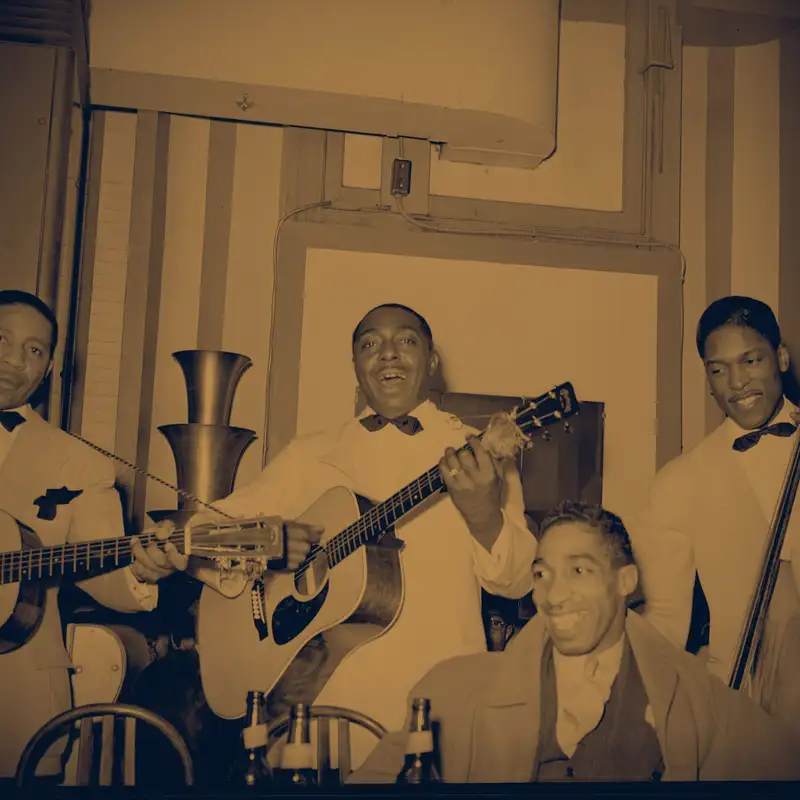
Episode artwork: Russell Lee, "Entertainers at Negro tavern. Chicago, Illinois," April 1941. Farm Security Administration/Office of War Information Collection, Library of Congress. No known restrictions on publication.
Groundwater draws from Race Records: The Lie That Split American Music — and the Blues That Ran Underneath by Thomas Stubbs.
Next episode: two more rooms, and then a fifth. A converted movie theater in South Memphis with a floor that still slopes toward where the screen used to be. A cinder-block building in Alabama that used to sell caskets, where four white men played behind Aretha Franklin. And a room in Harlem where the walls went up on purpose. The Rooms Where the Walls Came Down, Part 2: Stax, Muscle Shoals, and Minton's Playhouse.