Rooms Where the Walls Came Down Part 1: Sun Studio and Chess Records
Download MP3Ep 8 — Rooms Part 1: Sun Studio and Chess Records
===
Thomas Stubbs: [00:00:00] On the night of July 5th, 1954, in a storefront studio at 706 Union Avenue in Memphis, Tennessee, a 19-year-old truck driver was flailing. He had been in a room for hours with a guitarist named Scotty Moore and a bass player named Bill Black, trying to cut something usable. Nothing was usable. Stiff pop ballads and wrong keys and dead air.
During a break, fooling around, the kid started singing the blues. Arthur Big Boy Crudup's That's All Right, a black man's song. He sang it loose and fast and happy. Moore picked up the rhythm. Black slapped his bass. The man behind the control room glass stuck his head out. What are you doing? He asked. We don't know, they said.
Well, back up, the [00:01:00] man said. Try to find a place to start and do it again. They did it again, and it sounded like this. That's All Right, Elvis Presley, Sun Records, 1954. Listen to what the voice is doing. He wasn't singing black, he wasn't singing white, he was singing the thing that existed before the categories, the thing the categories had invented to suppress.
The flip side of the single was Bill Monroe's Blue Moon of Kentucky, bluegrass, filed under hillbilly, as white as Crudup's blues was black. Elvis sang it with the same loose-hipped energy, and the two sides of the single were the same music delivered with the same feel. If the shelves had been real, if race and hillbilly had described actual musical differences instead of marketing decisions, you couldn't have fit both sides on the same record.
But you could, so [00:02:00] The man behind the glass was named Sam Phillips. His studio was one of four rooms where the shelf system stopped working. This episode is about those rooms
This is Groundwater. I'm Thomas Stubbs. Episode eight: The Rooms Where the Walls Came Down Two episodes ago, we watched the recording industry build two shelves out of one music. Last episode, we watched the government remove the man who spent a decade breaking those shelves over the radio. This episode is about the places where the shelves fell down on their own.
Not metaphorical places, physical ones, buildings with addresses and electrical bills and mice in the walls.
Four rooms, two of them this episode,
Thomas Stubbs: The shelves were built in the 1920s. Ralph Peer stacked them, race records on one side, [00:03:00] hillbilly on the other, and the industry maintained them for the rest of the century, repainting and relabeling, but never tearing them down.
By the time most Americans encountered the genre system, it felt as natural as gravity. Of course, there's a country station and an R&B station, the way there's a morning and an afternoon. Nobody remembers that somebody decided where morning ends and afternoon begins. But in a handful of recording studios in the American South and its diaspora, where musicians were left alone together with a microphone and a tape machine, the categories simply ceased to function.
Not because the musicians were making a political statement. Most were just trying to cut a record before the session time ran out. The walls came down because the walls had never been load-bearing. They were partitions erected by the marketing department, maintained by the sales force, enforced by the radio programmers.
Remove those [00:04:00] people from the room, leave only the musicians, and the partitions collapse under their own irrelevance. The four rooms are all in the same part of the country, two in Memphis, one in northern Alabama, and one in Chicago, which for the purpose of this argument is a southern city because the South Side was built by the Great Migration by people who had ridden the Illinois Central up the Mississippi, and the music they made there was Delta blues plugged into an amp.
All four rooms were built by outsiders. An Alabama dreamer, two brothers from Poland, a country fiddler who wandered into a black neighborhood, a sharecropper's son. These outsiders were not saints. They were businessmen. Some of them got rich while the musicians who made the rooms legendary did not. The rooms were real.
The accounting was also real Sam [00:05:00] Phillips grew up on a cotton farm outside Florence, Alabama, 40 miles from Muscle Shoals. He picked cotton alongside black field hands as a child. He listened to what they sang while they worked. He heard something in it that he spent the rest of his life trying to get on tape.
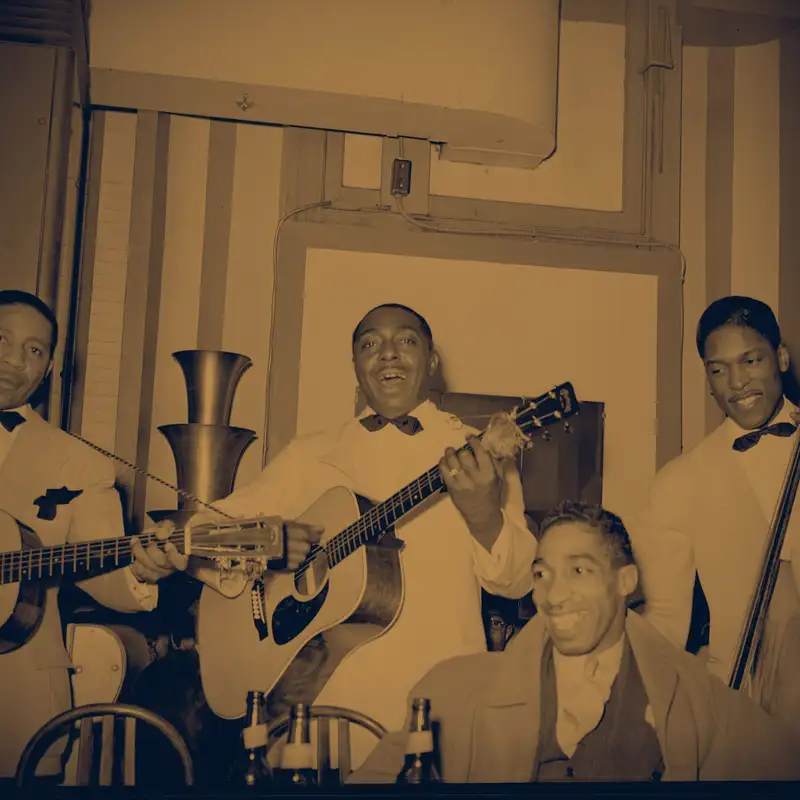
On January 3rd, 1950, he opened the Memphis Recording Service at 706 Union Avenue, a storefront, one room. The slogan on the window: "We record anything, anywhere, anytime." He recorded weddings, funerals, anybody who walked in with four dollars and a song. What he was looking for was the blues, and he found it immediately because in Memphis in 1950, it was everywhere.
He recorded B.B. King's first sessions. He recorded Howlin' Wolf, Chester Burnett, six foot three, a voice like a diesel engine dragging a chain through gravel. In [00:06:00] 1951, a 19-year-old named Ike Turner brought a band up from Clarksdale, Mississippi. On the drive, the guitar amplifier fell and the speaker cone tore.
Phillips stuffed the cone with wadded newspaper and liked what it sounded like rocket 88, Jackie Brenston & His Delta Cats, really Ike Turner's band, Chess Records, 1951 Hear the buzz under the guitar? That's the torn speaker cone. And the newspaper. A generation of music historians would call this the first rock and roll record. The claim, of course, is arguable, and people have been arguing it ever since, which is what happens when you try to pin a first date on something already happening in ten cities at once.
A black band from the Mississippi Delta recorded by a white Alabamian in Memphis, released on a label owned by Polish Jewish [00:07:00] immigrants in Chicago. It went to number one on the R&B chart. Phillips launched Sun Records in 1952. For two years, Sun was a blues label. The room at 706 Union was a black room making black music for black audiences.
Then the kid walked in. You heard what happened at the top of the show. There's a famous quote attributed to Phillips, "But if he could find a white man with a Negro sound and a Negro feel, he could make a billion dollars." The quote has followed him for seven decades, and the sourcing is a mess.
The earliest version comes from his assistant, Marion Keisker, recalling it years after the fact. Phillips himself gave varying accounts. What isn't disputed is the commercial logic underneath. The music was already one thing. The market was two things. Phillips built his business in the gap.
Whether that makes him a visionary [00:08:00] or a profiteer depends on which side of the gap you were standing on. Arthur Crudup, who wrote That's All Right, died in 1974, still trying to collect royalties from songs that had made other people famous. Phillips had not made Crudup famous. Phillips had made Elvis famous for singing Crudup's song.
Nobody ever resolved the difference Phillips took the acetate to a disc jockey named Dewey Phillips, no relation, who played it on WHBQ. The phone lines lit up. Dewey played it seven times in a row. Then he called Elvis in for an interview and made sure to ask him where he'd gone to high school.
Humes on the north side of Memphis, which told the listeners what they needed to know. The kid was white The fact that the question needed asking was the proof. You couldn't tell from the voice. After Elvis left for RCA, sold for thirty-five thousand dollars, the door at [00:09:00] 706 Union kept swinging. Johnny Cash from Dyess, Arkansas, Carl Perkins from Jackson, Tennessee, Jerry Lee Lewis from Ferriday, Louisiana, Roy Orbison from Wink, Texas.
None of them fit a category all of them sang into the same room where howlin' wolf had howled. On December 4th, 1956, Perkins was making new tracks. Lewis was playing session piano, Elvis dropped in to say hello, and Cash came to listen. Nobody planned it. The engineer left the tape running.
They played forty-six songs. Gospel, country, R&B, Christmas songs because it was December. Four voices tangling together because they'd all grown up poor in the rural South on the same radio stations and the same church choirs, black and white. In that room on that afternoon, the music remembered what the industry had worked so [00:10:00] hard to make it forget The newspaper called it the Million Dollar Quartet.
Whether Cash was actually singing or just standing in the photograph is still disputed. The photograph says he was there. The tapes are less clear. 706 Union Avenue is still standing. You can take the tour. You can stand on the X taped to the floor. The building was designated a National Historic Landmark on July 31st, 2003.
Sam Phillips had died the day before
lazor and Fizel were born in Motal, a rural town in what was then Poland. They arrived in Chicago in 1928. Boys, Jewish, speaking no English, their father opened a junk shop at 2979 South State Street, and the boys worked the counter That's the origin of the most important blues [00:11:00] label in American history, a junk shop, two Polish kids sorting scrap metal, the South Side pressing against the windows LeZor became Leonard.
Fizzle became Phil. America required the transformation. By forty-six, Leonard was running the Mocambo Lounge, a nightclub in a black neighborhood, and standing behind the bar watching what happened in the room when the music was right. The insight that built a label was a nightclub owner's insight. Nobody was recording it.
Nobody was capturing what the room felt like McKinley Morganfield had come up from Clarksdale in 1943, riding the Illinois Central, the same way Louis Armstrong had ridden it 21 years earlier.
In the Delta, he'd been recorded by Alan Lomax for the Library of Congress. Acoustic slide guitar, the raw sound of the juke joints. In Chicago, the juke joints were louder. Muddy Waters plugged in.
[00:12:00] Rolling Stone, Muddy Waters Chess Records, 1950. One of the first releases after the brothers renamed the label. Nine years earlier, Lomax had recorded the same man on a porch in Mississippi playing acoustic. Same notes, same blues. What changed is the amplifier, loud enough to fill a South Side club on a Saturday night and shake the walls of the building next door.
That's the Great Migration documented on tape What followed was a decade that defined a genre: "Hoochie Coochie Man," "Mannish Boy," most of them written by Willie Dixon, six foot six, a former Golden Gloves boxer from Vicksburg. He was the label's secret engine. Dixon wrote for Muddy, for Howlin' Wolf, for Little Walter and Bo Diddley and Koko Taylor.
The Chess brothers paid him a salary and published his songs through their own company, Ark Music, [00:13:00] and the royalty arrangements were, to use the most charitable possible description, not favorable to the songwriter. Chuck Berry walked in from St. Louis in 1955 because Muddy Waters told him to. He brought a song called "Ida Red."
It left the building as "Maybellene," and the names on that writer credit were last episode's story. The episode story is in the room. Berry's guitar intro on "Johnny B. Goode," recorded at 2120 South Michigan in 1958, is the riff that launched rock & roll guitar. Every rock guitarist who followed is playing a variation of what Chuck Berry figured out in that room
The building at 2120 South Michigan became the studio in 1957. It wasn't glamorous. A two-story commercial building, control room, studio floor, offices upstairs, where Leonard produced sessions [00:14:00] himself. Leaning through the control room glass, chain-smoking, telling the musicians to do it again, do it different, do it like you mean it.
He could not read a chart, but he could hear a thing The economics of Chess Records are the economics of the American music industry compressed into a single ledger. The brothers got very rich. The artists in many cases did not. Muddy Waters and Willie Dixon both sued in the 1970s for unpaid royalties.
The Chess brothers were not worse than their competitors. They were not better. They were the industry. But the argument against them is incomplete, because they were also the ones who showed up. Atlantic was in New York.
Columbia was in New York. The Chess brothers were on the South Side in the room at two in the morning while Muddy [00:15:00] made another take. The exploitation and the intimacy happened in the same building, sometimes in the same hour. The music industry has never figured out how to separate the two.
And then the English kids showed up. In June 1964, the Rolling Stones made their pilgrimage to 2120 South Michigan. They did not come to meet Leonard Chess. They did not come to examine the business model. They came to stand in the room where the records were made, believing with the fervor of converts that the room itself contained something that could not be transmitted through vinyl.
They might have been wrong about the mysticism. They were certainly right about the room. They made fourteen songs in two days, including "It's All Over Now," their first number one in Britain, and the first acoustic sketch of "Satisfaction," a band named after a Muddy Waters song recording in the building [00:16:00] where the song was made.
Leonard Chess sold the label in 1969 for six and a half million dollars. He died five months later at the age of fifty-two. Marie Dixon, Willie Dixon's widow, reopened the building as Willie Dixon's Blues Heaven Foundation. The songwriter, whose royalties the label underpaid for decades, now has his name on the door of the building where the underpayment happened.
I don't know if that's justice or irony or just what happens when enough time passes. Maybe it's all three .
This has been Groundwater, Episode 8, The Rooms Where the Walls Came Down, Part 1. I'm Thomas Stubbs. The book this episode draws from is called Race Records, The Lie That Split American Music and the Blues That Ran Underneath. Next [00:17:00] episode, two more rooms and then a fifth. A movie theater in South Memphis with a floor that still slopes towards where the screen used to be and the drummer who sat on that slope every night.
A cinder block building in Alabama that used to sell caskets where four white men played behind Aretha Franklin. And somebody, it stacks, took a phone call asking for the Jamaicans. And a room in Harlem where the walls went up on purpose. The Rooms Where the Walls Came Down, Part 2, Episode 9. Thank you for listening.
[00:18:00]