The Rooms Where the Walls Came Down, Part 2: Stax, Muscle Shoals, and Minton's Playhouse
Download MP3Muscle Shoals, Alabama, January 1967. Jerry Wexler brings Aretha Franklin, the daughter of the most famous Black preacher in America, to FAME Studios to record with four white session men she has never met, in a region where the Klan is a functioning organization. She walks in skeptical. The Swampers start playing. The skepticism ends before the first take is finished, and "I Never Loved a Man (The Way I Love You)" makes her the Queen of Soul.
This is the second of two episodes about the rooms where the recording industry's segregated shelf system stopped working, and it ends with a room where the walls went up on purpose.
Room three: 926 East McLemore Avenue, Memphis. Jim Stewart, a white country fiddle player, and his sister Estelle Axton, who mortgaged her house twice, rent an abandoned movie theater in a Black neighborhood and let the sloping floor do what it wants to the drums. Booker T. Jones, Steve Cropper, Duck Dunn, and Al Jackson Jr. as an integrated house band in a city where they could not legally eat together. "Green Onions" cut during a break in someone else's session. The neighborhood standing guard over the building during the riots after Dr. King's assassination. The Stax Museum, and the grade that is still wrong.
Room four: 3614 Jackson Highway, Sheffield, Alabama. A coffin showroom with burlap on the walls, bought by the Swampers when they walked out of FAME. WLAC and WDIA after dark. Spooner Oldham's electric piano. The Rolling Stones arriving to cut "Brown Sugar" and "Wild Horses" thinking they were at FAME. Paul Simon calling Stax for the Black Jamaican musicians on "I'll Take You There" and getting four white Alabamans instead.
Room five: Minton's Playhouse, 210 West 118th Street, Harlem. Fletcher Henderson's charts and Benny Goodman's crown. Charlie Parker, Dizzy Gillespie, Thelonious Monk, and Kenny Clarke building music that could not be danced to, could not be booked into a ballroom, and could not be stolen. "Ko-Ko" as the fence. The toll the builders paid. And why America preserves the rooms where the walls came down and let the room where the wall went up change shape until it was gone.
Music in this episode
- "Guitar Rag" — Sylvester Weaver (OKeh, 1923). Public domain. Series theme.
- "Green Onions" — Booker T. & the M.G.'s (Stax, 1962)
- "I Never Loved a Man (The Way I Love You)" — Aretha Franklin (Atlantic, 1967)
- "Ko-Ko" — Charlie Parker (Savoy, 1945)
All excerpts are used as direct commentary on the specific recordings discussed.
Episode artwork
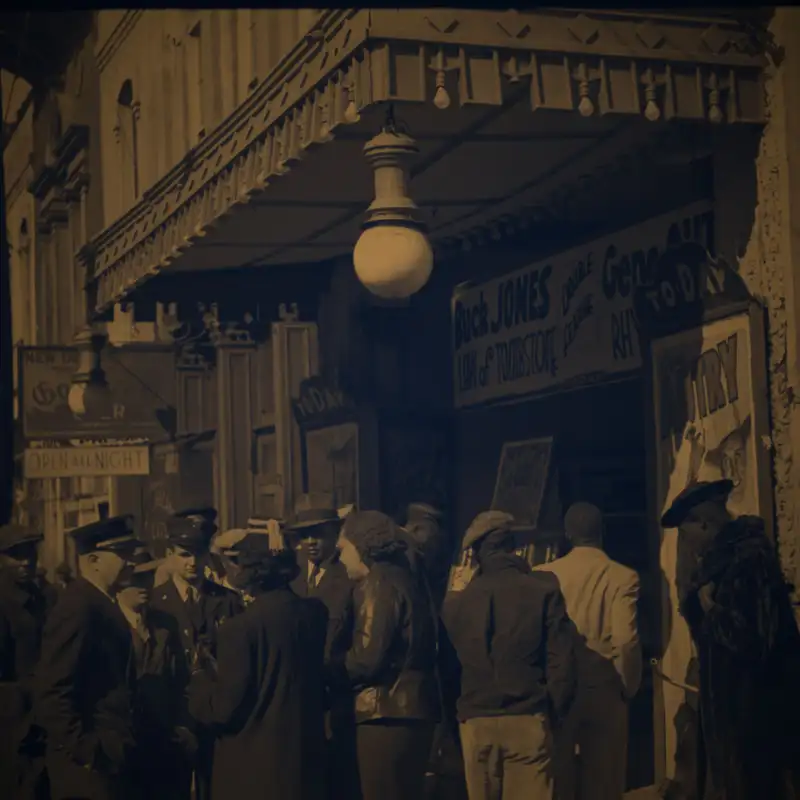
Marion Post Wolcott, Entrance to a movie house, Beale Street, Memphis, Tennessee, October 1939. Farm Security Administration/Office of War Information Collection, Library of Congress. No known restrictions on publication.
Marion Post Wolcott, Entrance to a movie house, Beale Street, Memphis, Tennessee, October 1939. Farm Security Administration/Office of War Information Collection, Library of Congress. No known restrictions on publication.
Groundwater draws from Race Records: The Lie That Split American Music — and the Blues That Ran Underneath by Thomas Stubbs.
Next episode: the river goes underground. A man in a rhinestone suit who refused to believe American music had walls, buried at the headwaters. A father and a son who never knew each other, with one song between them. And a current that kept running even when nobody could see it. The Underground River.