The Rooms Where the Walls Came Down, Part 2: Stax, Muscle Shoals, and Minton's Playhouse
Download MP3[0:00]
Jim Stewart was a country fiddle player. That is the fact that makes the Stax story impossible to file. A white man who played country fiddle founded the label that would define Memphis soul: Otis Redding, Sam and Dave, the Staple Singers, Isaac Hayes.
He didn't set out to record Black music. He set out to record music. His sister, Estelle Axton, twelve years older, a bank teller with a stubbornness more consequential than any business plan, mortgaged her house to buy him a tape recorder. When that wasn't enough, she mortgaged it again. In 1960, they rented the abandoned Capitol Theatre at 926 East McLemore Avenue in South Memphis. A Black neighborhood. Stewart chose it because it was near where the musicians were. He moved into the neighborhood instead of asking the neighborhood to come to him.
[1:02 — Theme: Sylvester Weaver, "Guitar Rag"]
[1:11]
This is Groundwater. I'm Thomas Stubbs.
Episode nine. The Rooms Where the Walls Came Down, part two.
Three episodes ago, we watched the recording industry build two shelves out of one music. Last episode, we stood in two of the rooms where the shelves fell down on their own: a storefront studio in Memphis, and a junk shop family's label on the South Side of Chicago.
This episode, two more rooms. A movie theater with a sloping floor. A coffin showroom in Alabama.
And at the end, a fifth room, where the walls went up on purpose.
[1:56]
The Capitol Theatre was built to show movies. The floor sloped toward the screen. Thirty-five hundred square feet of raked concrete. Stewart couldn't afford to level it. He built the control room where the screen had been, carpeted over the slope, and let it do whatever it was going to do to the sound. What it did was deaden the low frequencies in a way no engineer had planned, and no engineer could replicate. A warm, dry room that pushed the midrange forward and gave the drums a punch.
Estelle ran a record shop in the old concession stand. She would play new Stax recordings for the neighborhood kids who came in after school, and she'd watch their feet. If the kids danced, the record was a hit. If they stood still, it wasn't.
Booker T. Jones lived a few blocks away. He was a teenager playing sessions before he was old enough to drive. Steve Cropper, a white guitarist from the Ozarks, was already in the building. Duck Dunn, another white guy from Memphis, played bass. Al Jackson Jr., a Black drummer, kept time other drummers described as inhuman. Two Black musicians, two white musicians, in Memphis in the early 1960s, in a city where a Black man and a white man could not legally eat at the same lunch counter.
Inside the building, none of that existed. The building had its own rules, and the rules were musical. Can you play?
"Green Onions." Booker T. and the M.G.'s. Stax Records, 1962. Recorded almost by accident during a break in someone else's session.
[3:44 — "Green Onions," Booker T. & the M.G.'s (Stax, 1962)]
An instrumental. No lyrics, no singer, no message except the groove itself. Number one on the R&B chart, number three pop. Listen to the drums. The dry punch is a theater floor. Al Jackson sat behind his kit on that slope night after night, and the angle may be part of why Stax's bottom end was never quite matched. The floor was never studied before the building came down. What remains is a replica and a theory.
The band backed everyone. Otis Redding, who sang like every song was the most important thing that had ever happened to him, and who sang country, and covered the Rolling Stones' "Satisfaction": a white English band's song, built on Black American R&B, covered by a Black American soul singer. If you try to draw the genre lines on that transaction, you will run out of ink before you run out of contradictions.
The room's greatest test came on April 4, 1968, when Martin Luther King was assassinated at the Lorraine Motel in Memphis, a motel where Stax staff regularly ate and socialized, where "Knock on Wood" had been written. The city burned. Places near the studio were attacked. Stax was left untouched. The neighborhood protected it. Or more precisely, the neighborhood recognized that the building was theirs in a way the other buildings on the block were not.
But the assassination changed the temperature. Stax was still a company owned by white people in a Black neighborhood, and the power dynamics were not equal even when the groove was the same. Closeness in a studio is not the same as equality on an org chart. The family fractured along lines the music had spent eight years dissolving, and Stax went bankrupt in 1975. The building was demolished in 1989.
What stands on the site now is the Stax Museum of American Soul Music, opened in 2003, built around the footprint of Studio A. Deanie Parker, who joined Stax as a teenager and who for years drove the other way on McLemore so she wouldn't have to see the empty lot, spent a decade convincing Memphis that the room mattered. The sloping floor has been preserved. The grade is still wrong.
[6:49]
The building had been a coffin showroom. Before four session musicians pooled their savings and bought it in 1969, the concrete-block structure at 3614 Jackson Highway in Sheffield, Alabama, was where a man displayed caskets for sale. The walls were covered in burlap. The one bathroom doubled as a sound booth. A loud truck on the street meant you stopped recording.
I keep wanting to make something poetic out of the caskets. The truth is the Swampers bought the building because they could afford it and it was close to FAME. The caskets were a detail, not a metaphor.
The Swampers had been the house band at Rick Hall's FAME Studios, a mile and a half up the road. Hall was a sharecropper's son from Mississippi: smart, demanding, and very tight with money. The best rhythm section in the country on union scale. When Hall signed an exclusive deal that would have locked them in permanently, they walked. Hatched the plan in a booth at a pizza parlor, bought the coffin showroom with their savings and a loan from Jerry Wexler at Atlantic, and opened Muscle Shoals Sound Studio on April 1, 1969.
Jimmy Johnson, guitar. David Hood, bass. Roger Hawkins, drums. Barry Beckett, keys. Four men, white, who grew up listening to Black radio. WLAC out of Nashville, WDIA out of Memphis, the clear-channel stations that beamed R&B and gospel across the South after dark, when the white stations signed off and the airwaves belonged to Howlin' Wolf and the Staple Singers. By the time they were session men, whether four white men could play Black music was not a question they thought about. They were playing the music they'd grown up on.
The proof arrived in January 1967, before they'd even left FAME. Jerry Wexler brought Aretha Franklin to Muscle Shoals. Now think about that for a minute. Aretha Franklin, the daughter of the most famous Black preacher in America, a woman who carried the entire weight of the gospel tradition in her throat, brought to a studio in northern Alabama to record with four white men she'd never met, in a region where the KKK was not a historical memory but a functioning organization.
Wexler later admitted he was nervous. Franklin was skeptical. She walked into the studio and the Swampers started playing. The skepticism ended before the first take was finished.
"I Never Loved a Man." Aretha Franklin. Atlantic Records, 1967. Recorded at FAME on January 24 of that year.
[9:57 — "I Never Loved a Man (The Way I Love You)," Aretha Franklin (Atlantic, 1967)]
The electric piano on the intro, a few notes, a shimmer, one of the most recognizable sounds in recorded music, was played by Spooner Oldham, a white man from Center Star, Alabama. And that groove, churchy and dirty at the same time, is what gave Aretha permission to sing the way she sang in her father's church. This is the session where she stopped being a talented singer making polite records nobody bought, and became the Queen of Soul.
Unfortunately, the session fell apart before the album was finished. An altercation involving Aretha's husband, a trumpet player, alcohol, and the accumulated tension of a Black entourage in a white Alabama town. The details depend on who tells it. Wexler pulled the session and finished the album in New York, but he flew the Swampers up with her, because no session musicians in New York could play what they played.
The notion that the music dissolved every friction, that the room simply erased what Alabama was in 1967, is a story that the room likes to tell about itself. Aretha left Alabama and did not come back.
When the Swampers opened 3614, the business followed the sound. The Rolling Stones came in 1969 and made "Brown Sugar" and "Wild Horses" in the coffin showroom, having arrived, per Rick Hall's dry summary, thinking they were cutting at FAME.
And then there's the Paul Simon story. In '72, Simon wanted the musicians who had played on the Staple Singers' "I'll Take You There." He called Stax and asked for the Black Jamaican musicians on that record. Al Bell said he could give Simon their number, but they were mighty pale. Simon booked four sessions for one song. The Swampers nailed it on the second take. With the time left over, he cut "Kodachrome."
The building has been a pro-audio shop, an appliance repair store, an abandoned shell with the address painted on the block. In 2017, it reopened as a museum and a working studio. The burlap on the walls dates to 1969. David Hood, the bass player, is in his eighties and still stops by. When asked how four white men from Alabama learned to play like that, he gives some version of the same answer every time. "We didn't learn to play like anything. We played like us."
[13:12]
There is a room where the walls went up on purpose, and it deserves a hearing, because it proves the thesis from the other side.
In the 1930s, a Black arranger named Fletcher Henderson sold his charts to a white clarinetist named Benny Goodman. Henderson's arrangements, the voicings, the swing, were the architecture of the big-band sound. Goodman played them, and the result was the swing era, and the result of the swing era was that Benny Goodman became the King of Swing. A white man crowned king of music built on a Black man's blueprints. Henderson got paid for the arrangements. He didn't get paid for the crown. It was the pattern the industry had run since 1917: Black creation, white popularization, institutional reward. The swing era didn't invent the theft, but it did industrialize it.
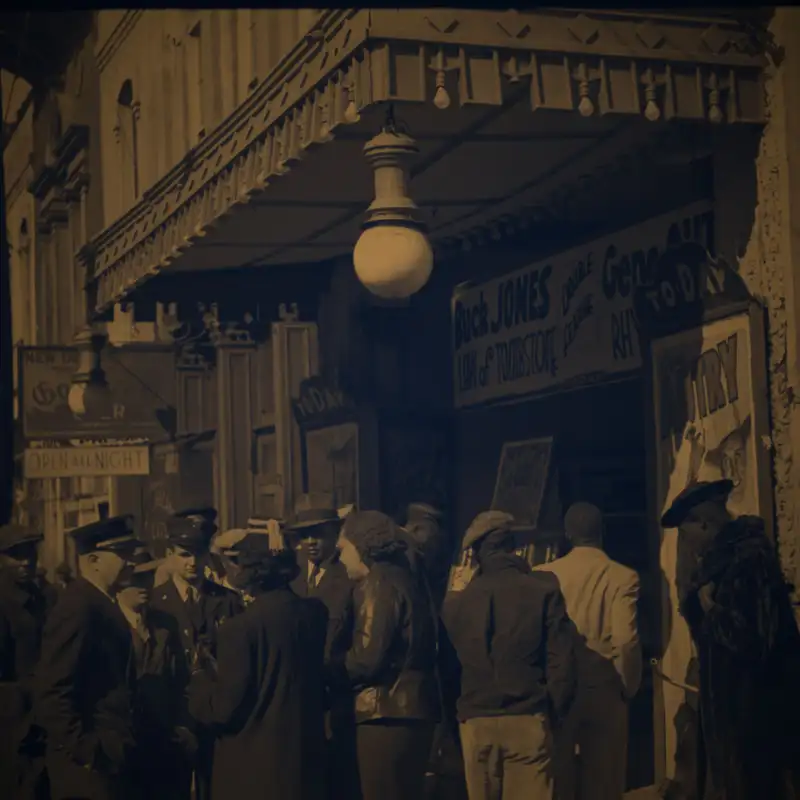
In the early 1940s, in a Harlem nightclub called Minton's Playhouse, Charlie Parker and Dizzy Gillespie and Thelonious Monk and Kenny Clarke looked at this arrangement and decided to make it impossible. They did not write a manifesto. They wrote music. They made it faster: tempos a swing band couldn't sight-read. They made it harmonically dense: substitutions piled on substitutions, structures you needed ten thousand hours to navigate. They made the accents fall in places that made dancing impossible, because dancing was the point. If you couldn't dance to it, you couldn't put it in a ballroom. If you couldn't put it in a ballroom, you couldn't sell it to a white audience. And if you couldn't sell it to a white audience, you couldn't steal it. The complexity was the fence.
"Ko-Ko." Charlie Parker. Savoy Records, 1945.
[15:14 — "Ko-Ko," Charlie Parker (Savoy, 1945)]
Built on the chord changes of "Cherokee," played at a tempo that makes most saxophonists' fingers cramp listening to it. You can't put this on a dance floor. It is music designed to be recognized as art. The recognition it demands is specific: that the person playing it is not an entertainer but an artist, not a servant but a sovereign.
It worked. No white swing band successfully appropriated bebop. No Benny Goodman emerged to claim the crown of bop king. The Henderson-to-Goodman pipeline could not function. The toll, however, was real. Parker dead at thirty-four. Monk institutionalized. Bud Powell's mind broken by a police beating. And the fence had costs its builders could not have foreseen: it kept the appropriators out, but it kept most of the audience out too. Jazz went from the most popular music in America to a minority taste. The musicians knew this and built it anyway, because the alternative, watching the pipeline run one more time, was worse.
[16:54]
So, two facts.
Fact one. When you put musicians in a room and remove the marketing infrastructure, the genre walls dissolve. Phillips recording Howlin' Wolf and Elvis with the same microphone. Four musicians playing as one instrument on a sloping floor. Four white Alabamans playing behind Aretha Franklin so convincingly that Paul Simon assumed they were Black Jamaicans. The music was never segregated, but the industry was.
Fact two. When Black musicians decided to build a wall of their own, they built one that held.
Both facts prove the same thesis. Both facts prove it from different directions.
The four studios are landmarks now, three of them anyway, plus a museum that preserves a sloping floor. You can visit all of them. You can stand where Muddy stood, where Elvis stood, where Aretha stood. Minton's Playhouse, at 210 West 118th Street in Harlem, has been through half a dozen incarnations: jazz club, bar, supper club, closed again, renovated past recognition. So the original room is gone. There is no landmark designation, and no foundation or museum, no tour. America preserves the rooms where the walls came down. It let the room where the wall went up on purpose change shape until it was no longer the same room.
[18:33]
In Louis Armstrong Park in New Orleans, a few years after Katrina, the buildings were wrecked. Roofs peeled back, walls stoved in. Congo Square was still there. The live oaks that had shaded the Sunday dances in the eighteenth century had survived the storm the way they'd survived everything else: by being older than the architecture, and not very impressed by it.
Some things last because they were built to sell tickets, and some things last because they were planted in the ground before tickets existed. The difference between the two is not always the difference you want it to be.
[19:16]
This has been Groundwater. Episode nine. The Rooms Where the Walls Came Down, part two. I'm Thomas Stubbs. The book this episode draws from is called Race Records: The Lie That Split American Music and the Blues That Ran Underneath.
Next episode, the river goes underground. A man in a rhinestone suit who refused to believe American music had walls, buried at the headwaters. A father and a son who never knew each other, with one song between them. And a current that kept running even when nobody could see it. The Underground River. Episode ten.
Thank you for listening.
[20:00 — Theme: Sylvester Weaver, "Guitar Rag"]
Music in this episode
"Guitar Rag" — Sylvester Weaver (OKeh, 1923). Public domain. Series theme.
"Green Onions" — Booker T. & the M.G.'s (Stax, 1962)
"I Never Loved a Man (The Way I Love You)" — Aretha Franklin (Atlantic, 1967)
"Ko-Ko" — Charlie Parker (Savoy, 1945)